As AI video, real-time live streaming, and generative media rapidly evolve, the demand for GPU hash power and bandwidth in video infrastructure keeps rising. Traditional video platforms often rely on centralized cloud services, but high operational costs and closed resource models are fueling the growth of decentralized video networks.
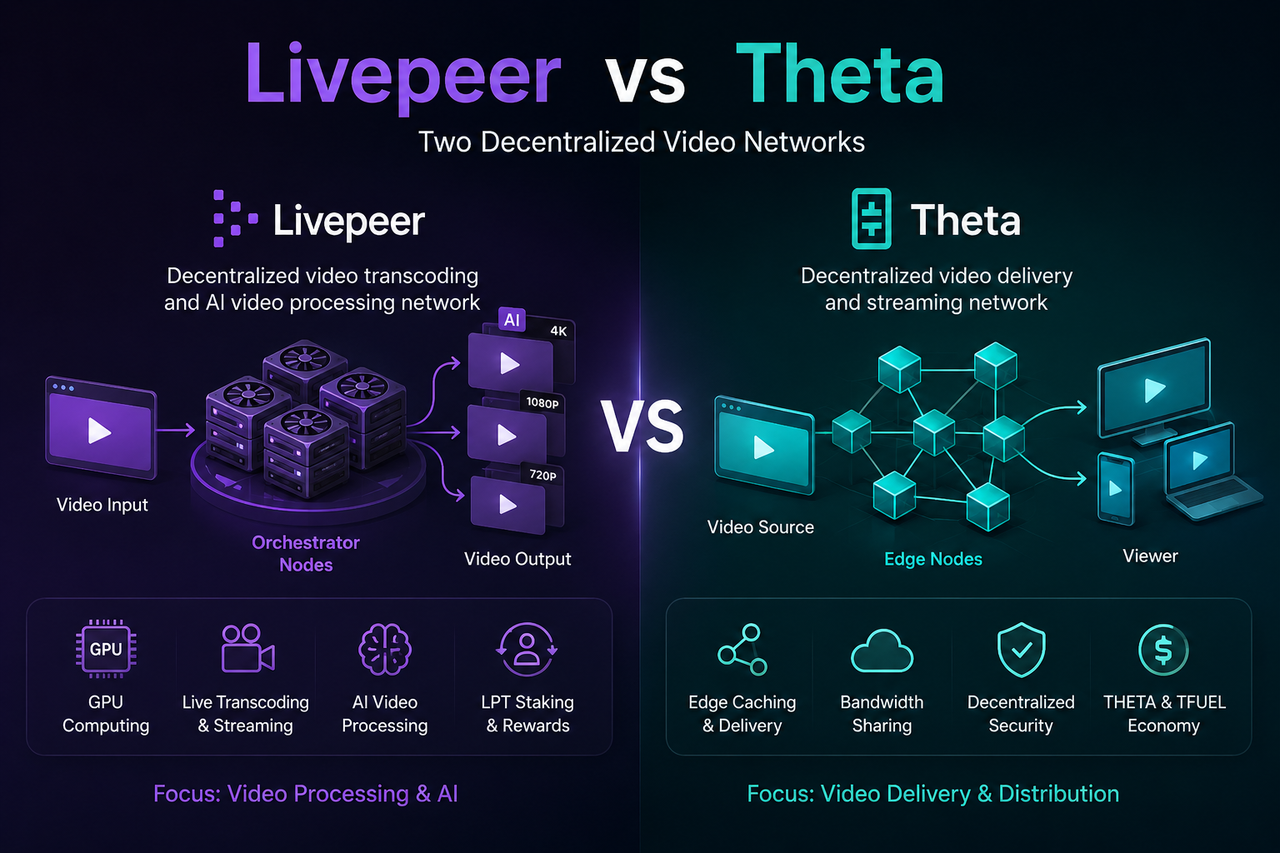
Livepeer and Theta are both decentralized video infrastructure solutions, each representing a distinct technical path. Livepeer aligns more closely with GPU video computing networks, while Theta functions more as a decentralized CDN and streaming distribution network.
Livepeer vs. Theta: Overview
Livepeer, built on Ethereum, is a decentralized network for video and AI video infrastructure, with core strengths in video transcoding, live streaming processing, and real-time AI video computation.
Theta, designed for video content distribution and streaming, focuses on reducing video transmission costs and improving distribution efficiency through edge nodes.
Unlike Livepeer, Theta’s primary resources are bandwidth and edge caching rather than GPU computing. Users can run Edge Nodes to share network resources and help distribute video content across the platform.
How Do Livepeer and Theta Differ in Core Objectives?
While both Livepeer and Theta are video infrastructure projects, they tackle fundamentally different problems.
Livepeer is focused on “how video is processed.” Its core strengths are video transcoding, GPU-based video computing, and AI video inference, making GPU hash power the network’s most critical resource.
Theta is focused on “how video is delivered.” Its goal is to lower streaming transmission costs through edge nodes and bandwidth sharing, making bandwidth and cache capacity the network’s key resources.
From an industry perspective, Livepeer is positioned as AI video infrastructure, while Theta is geared toward decentralized streaming and content distribution.
Network Architecture: Livepeer vs. Theta
Livepeer’s network architecture is built around video computing. The Orchestrator node is central, handling video tasks and leveraging GPU resources for processing. The Gateway connects applications to the network and routes tasks to various nodes.
Theta’s architecture prioritizes content distribution efficiency. Its network includes Validator Nodes, Guardian Nodes, and Edge Nodes, with Edge Nodes responsible for video caching and bandwidth sharing.
Functionally, Livepeer’s Orchestrator acts as a distributed GPU computing node, whereas Theta’s Edge Node serves as a decentralized CDN node.
This structural difference defines their distinct positions within the video ecosystem.
How Do Livepeer and Theta Process Video Tasks?
On the Livepeer network, uploaded videos are assigned to Orchestrator nodes. These nodes utilize GPU resources to transcode video, generating outputs tailored for different devices and network environments.
With the rise of AI video, Livepeer’s GPU nodes can also handle real-time AI video tasks such as style transfer, AI Avatar rendering, and video enhancement.
Theta’s task processing logic is different. Theta is focused on video content caching and efficient distribution. Edge Nodes cache video and provide users with near-local video delivery, reducing server strain on the platform.
In summary, Livepeer is more specialized in the video computing layer, while Theta specializes in the video distribution layer.
Why Is AI Video Capability a Key Differentiator?
AI video is a defining trend in the Web3 video space and a key reason for the widening gap between Livepeer and Theta.
Livepeer has steadily expanded its real-time AI video capabilities, including AI Avatars, video generation, real-time inference, and video enhancement. These tasks demand significant GPU hash power, positioning Livepeer’s architecture as inherently optimized for AI video.
Theta is also exploring AI and edge computing, but its network design remains fundamentally centered on video distribution and streaming.
As a result, Livepeer holds a clearer position in the AI video infrastructure domain.
Token Models: Livepeer vs. Theta
Livepeer uses LPT as its core coordination token, primarily for node staking, network security, and task allocation. Orchestrators must stake LPT to receive video tasks, while Delegators can participate in network rewards through delegation.
Theta implements a dual-token model: THETA is used for governance and validation, while TFUEL pays for network resources and video distribution costs.
In comparison, Livepeer’s tokenomics emphasize GPU computing coordination, while Theta’s system is tailored for streaming and content distribution.
Ecosystem Direction: Livepeer vs. Theta
As the sector evolves, the two have developed along increasingly distinct ecosystem tracks.
| Comparison Dimension |
Livepeer |
Theta |
| Core Positioning |
Video Transcoding & AI Video |
Video Distribution & CDN |
| Core Resource |
GPU Hash Power |
Bandwidth & Caching |
| Network Role |
Orchestrator |
Edge Node |
| AI Video Capability |
Strong |
Moderate |
| Main Application |
AI Video, Live Transcoding |
Streaming Platforms |
| DePIN Attribute |
Strong |
Moderate |
Currently, Livepeer is most often classified as AI video infrastructure and a decentralized GPU network, while Theta continues to build out its decentralized streaming ecosystem.
Summary
Livepeer and Theta are both decentralized video infrastructure platforms, but they represent distinct technical approaches.
Livepeer specializes in video transcoding, GPU video computing, and real-time AI video processing, with its core built on Orchestrator and GPU networks. Theta focuses on content distribution, edge caching, and efficient streaming transmission.
As the demand for AI video accelerates, Livepeer’s positioning as an AI video infrastructure provider is growing stronger, while Theta remains focused on video distribution and content ecosystem development.
FAQs
What is the biggest difference between Livepeer and Theta?
Livepeer focuses on video transcoding and AI video processing, while Theta is centered on video content distribution and edge networks.
Is Livepeer considered AI infrastructure?
With the advancement of AI Avatars, real-time video inference, and AI video generation, Livepeer has increasingly positioned itself as AI video infrastructure.
Does Theta provide GPU video computing?
Theta’s main focus is on video distribution and edge caching; its GPU video processing capabilities are relatively limited.
Why does Livepeer require GPU nodes?
Video transcoding and AI video inference require substantial GPU hash power, so Livepeer relies on GPU nodes for computing resources.
What is the function of Theta’s Edge Node?
Edge Nodes are used for video caching, content distribution, and bandwidth sharing.
Are both Livepeer and Theta DePIN projects?
Both are connected to decentralized infrastructure, but Livepeer’s GPU network attributes generally make it a stronger fit for the DePIN definition.







