In traditional DAOs, governance usually relies on token holder voting, but voter turnout, governance apathy, and costless decision making can all affect proposal quality. MetaDAO changes governance into a market trading process, allowing participants to express their judgment with capital and form governance outcomes through price discovery.
This process generally involves six layers: proposal creation, market launch, conditional market trading, TWAP finalization, Treasury execution, and user participation.
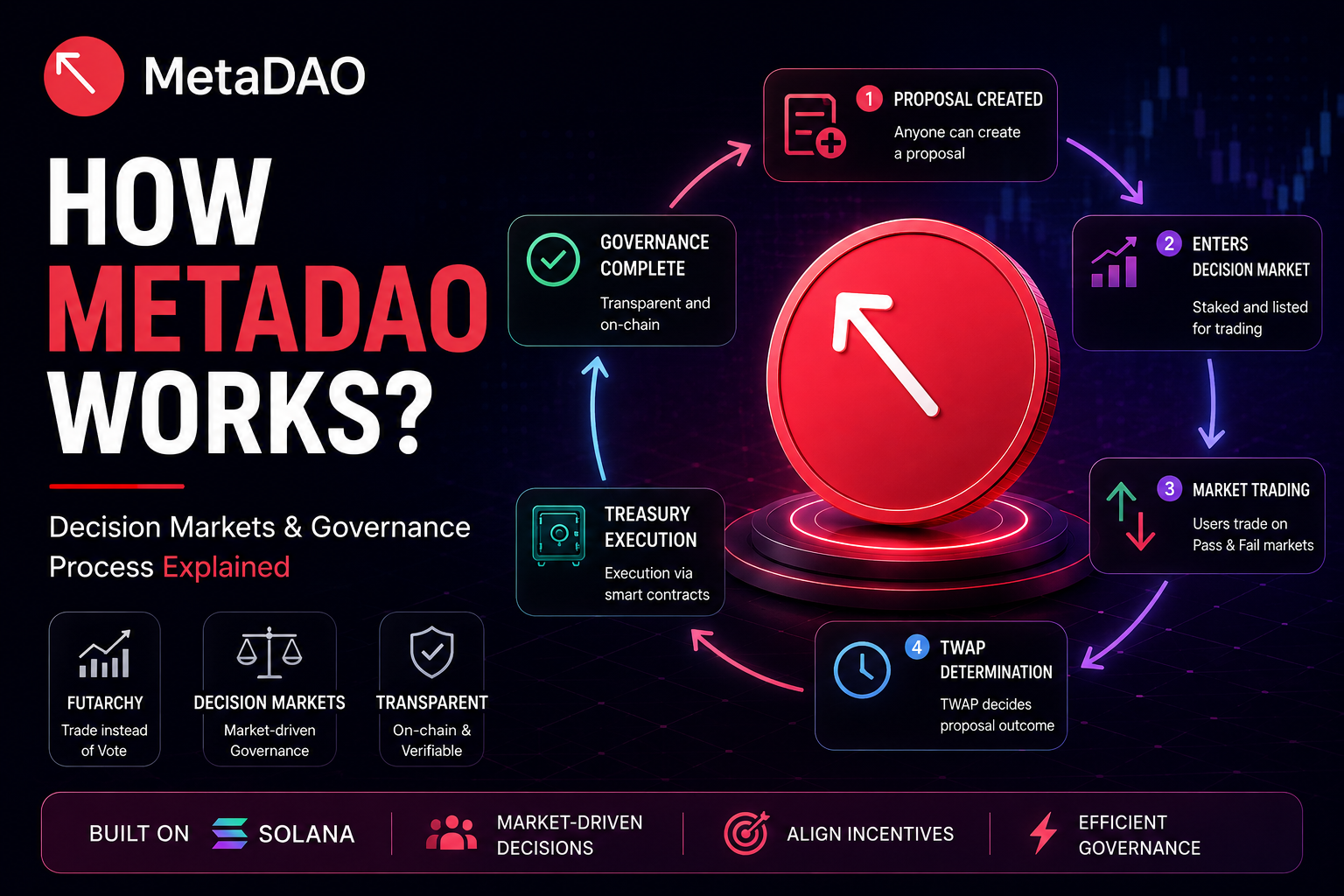
MetaDAO’s governance process can be understood as an on chain decision making mechanism based on Futarchy. Its core idea is to use market prices to judge whether a proposal should be executed. Instead of relying on a simple vote count, the mechanism forms governance signals through trading behavior.
Structurally, MetaDAO governance consists of proposals, staking thresholds, conditional markets, TWAP finalization, and on chain execution. First, users create governance proposals and publicly describe their content. Then, token holders need to stake a certain number of tokens for a proposal so it can meet the requirements to go live in the market. Next, the system opens two markets, Proposal Pass and Proposal Fail, where traders trade within a set period. Finally, the protocol decides whether the proposal passes or fails based on the TWAP result.
The official documentation explains that MetaDAO’s decision markets allow participants to trade two types of outcomes: “what happens to the token’s value if the proposal passes” and “what happens to the token’s value if the proposal fails.” The organization accepts a proposal when the market believes it will increase token value, and rejects it when the market believes it will reduce token value.
How Proposals Enter Decision Markets
Before a proposal enters a decision market, it must go through public creation and staking accumulation. In practice, MetaDAO uses a staking threshold to filter out low quality proposals and prevent governance resources from being consumed by ineffective proposals.
In the specific process, a user first creates a proposal. The proposal may involve Treasury spending, issuing new tokens, updating token metadata, or adjusting liquidity provided by the project Treasury. The proposal then needs token staking support before it can reach the required threshold and enter the market trading stage. Next, the system transfers part of the project’s spot liquidity into conditional markets, giving traders an environment for pricing. Finally, the proposal enters the Proposal Pass and Proposal Fail markets, where traders conduct price discovery.
The official documentation states that anyone can create a project proposal. By default, a proposal needs 200,000 to 1,500,000 tokens staked before it can go live, depending on the DAO version and parameters. The purpose of staking is mainly to prevent spam proposals, and it does not involve lockups or slashing risk.
The importance of this mechanism is that it preserves open proposal creation while improving the quality of the governance process through a staking threshold.
How Proposal Pass and Proposal Fail Work
Proposal Pass and Proposal Fail are the two conditional markets in MetaDAO’s decision market system. They respectively reflect “the token value if the proposal passes” and “the token value if the proposal fails.” The key point is that traders express their judgment of a proposal’s outcome by buying or selling in different markets.
In practice, the system first creates a pass market and a fail market for the same proposal. Traders then trade in the two markets based on their judgment. For example, they may buy in the Pass market if they believe the proposal will increase value, or buy in the Fail market if they believe the proposal will harm value. Market prices then change as trading activity unfolds, gradually forming expectations about the proposal’s impact on value. Finally, the system uses the price performance of the two markets to determine whether the proposal should be executed.
| Process Stage |
User Action |
System Action |
Governance Meaning |
| Create proposal |
Submit a governance plan |
Publicly record proposal content |
Establish the governance object |
| Stake support |
Stake tokens for the proposal |
Check launch requirements |
Filter low quality proposals |
| Open markets |
Trade Pass or Fail |
Create conditional markets |
Form price signals |
| TWAP finalization |
Wait for market settlement |
Calculate the weighted average price |
Decide the governance direction |
| On chain execution |
View execution result |
Execute or reject the proposal |
Complete the governance loop |
This table shows that MetaDAO’s governance process is not simple voting. Instead, it combines user behavior, market trading, and protocol execution into a complete governance chain.
How TWAP Determines Governance Outcomes
TWAP is the key mechanism MetaDAO uses to finalize proposal outcomes. Its role is to reduce the impact of short term manipulation and price shocks near settlement by using a time weighted average price.
In terms of process, the Proposal Pass and Proposal Fail markets first enter a three day trading period. Traders then continue buying and selling across the two conditional markets, forming a price sequence. After the trading period ends, the protocol compares the two market prices using the TWAP mechanism. Finally, if the Pass market’s TWAP is higher than the Fail market’s TWAP, the proposal passes and is executed. If the Fail market’s TWAP is not lower than the Pass market’s TWAP, the proposal fails and is rejected.
The official documentation explains that after a proposal receives enough staked support, it enters a three day conditional market trading period. When trading ends, the final result is determined through a TWAP mechanism with a lag design. If the Pass market TWAP is higher than the Fail market TWAP, the proposal is executed. Otherwise, the proposal is rejected.
The importance of this mechanism is that governance outcomes rely more on sustained market consensus, rather than price movement at a single moment.
How Treasury Funds Are Executed
Treasury execution is the result layer of MetaDAO’s governance process. Its core purpose is to turn proposals approved through market finalization into on chain funding operations or protocol operations.
In practice, a proposal first specifies the execution content, such as spending USDC, issuing new tokens, adjusting liquidity, or updating token metadata. The decision market then completes trading and TWAP finalization. If the proposal passes, the governance execution program carries out the on chain operation according to the proposal content. Finally, Treasury funds or token issuance are completed according to the path specified in the public proposal.
The official documentation notes that proposals can be used to spend USDC from the Treasury, issue new tokens, update token metadata, or adjust liquidity provided by the project Treasury. For issuance proposals, the proposal publicly specifies the mint amount, recipient address, and purpose, and execution is completed by the governance program rather than handled privately by a human operator.
The importance of this structure is that MetaDAO places Treasury control under a market based governance process, making fund execution public, verifiable, and rule driven.
Users can participate in MetaDAO governance mainly by creating proposals, staking support for proposals, trading decision markets, and observing on chain execution results. The key point is that participants are not only expressing opinions. They also bear the cost of judgment through capital.
From the participation path, users can first create proposals involving the Treasury, token issuance, or liquidity adjustments. Other token holders can then stake tokens for the proposal so it enters the trading stage. Next, traders can buy or sell in the Pass or Fail market to express their judgment about the proposal’s impact on value. Finally, users can view market trading, TWAP finalization, and proposal execution results through on chain data.
The official documentation emphasizes that conditional market trading is similar to ordinary trading, but if the relevant condition is not met, the trade is reverted. All trading activity is visible on chain in real time.
This form of participation means governance power does not come only from the number of tokens held. It also comes from traders’ ability to judge a proposal’s value. Market based participation increases the density of governance information, but it also requires users to understand conditional markets and price risk.
Conclusion
MetaDAO’s operating process is built around proposal creation, staking thresholds, conditional market trading, TWAP finalization, and on chain execution. Users first create or support proposals, the system then opens Proposal Pass and Proposal Fail markets, traders express their judgment through market prices, and the TWAP result ultimately determines whether a proposal is executed.
Overall, MetaDAO’s core innovation is using decision markets to replace traditional DAO voting. This process combines governance outcomes, market prices, and economic incentives, requiring governance participants to bear the cost of judgment through trading behavior.
FAQs
MetaDAO completes governance through proposals, staking, decision markets, TWAP finalization, and on chain execution. Proposals are not decided by ordinary voting, but by the price signals of the Pass and Fail markets.
What Are Proposal Pass and Proposal Fail
Proposal Pass and Proposal Fail are two conditional markets under the same proposal. They represent the expected token value if the proposal passes or fails. Traders express their judgment by buying and selling in these markets.
TWAP is used to compare the time weighted average prices of the Pass and Fail markets during the trading period. It can reduce the impact of short term price manipulation and determine whether the proposal ultimately passes.
MetaDAO’s core mechanism is not traditional voting, but market based governance built on Futarchy. Users mainly participate in forming governance outcomes through staking and trading decision markets.
How Are Treasury Funds Used
Treasury funds must go through the proposal and decision market process. If a proposal passes, the governance execution program completes the fund spending, token issuance, or liquidity adjustment according to the public proposal content.