In traditional finance, different institutions often operate on independent databases and clearing systems, resulting in inefficient asset transfers and a lack of real-time data synchronization. The “Synchronized Finance” architecture introduced by Canton allows multiple apps and subnetworks to share a unified state while operating independently, enabling institution-grade collaboration.
As RWA, digital securities, and on-chain payment networks continue to evolve, institutional markets are seeing growing demand for cross-chain interoperability. Canton’s privacy mechanisms and coordination layer design have positioned it as a leading solution for institutional blockchain infrastructure.
How Does Canton Enable Institutional-Grade Blockchain Interoperability?
Canton’s interoperability goes beyond basic “cross-chain transfers.” It enables real-time state sharing and atomic-level collaboration across different financial systems through a unified synchronization mechanism. The core goal is to allow multiple institutions, apps, and networks to jointly complete asset transfers, settlements, and contract execution—without exposing sensitive data.
What Is Blockchain Interoperability?
Blockchain interoperability is the ability of different blockchain networks or distributed systems to share data, transfer assets, and coordinate state.
In the early blockchain ecosystem, most networks operated in isolation. To move assets from one network to another, users typically relied on Bridges, custodial services, or third-party verification mechanisms. While these methods enabled basic asset transfers, they also introduced security risks, liquidity fragmentation, and data inconsistency.
For institutional finance, interoperability demands go beyond simply “moving assets.” Key requirements include:
- Synchronizing state across multiple systems
- Completing trades simultaneously
- Sharing data based on permissions
- Enforcing compliance rules consistently
As a result, institutional-grade interoperability is far more complex than cross-chain communication between public blockchains.
Why Do Institutional Finance Markets Need Interoperability?
System silos have long plagued traditional financial markets. Banks, securities firms, payment networks, and clearing systems often run on different technology stacks. Even for a single asset transaction, multiple intermediaries are needed for confirmation and synchronization.
For example, a cross-border securities trade may require several rounds of reconciliation among custodians, payment networks, clearing centers, and banking systems. Without a unified state synchronization mechanism, final settlement can take hours or even days.
With the rise of RWA, digital bonds, and on-chain payments, institutions are seeking to leverage blockchain for faster cross-system settlement, reduced reconciliation costs, improved data consistency, and more secure asset synchronization.
How Does Canton’s Global Synchronizer Work?
The Global Synchronizer is a core coordination layer powering Canton’s interoperability. It provides unified time sequencing and state synchronization for multiple apps and subnetworks.
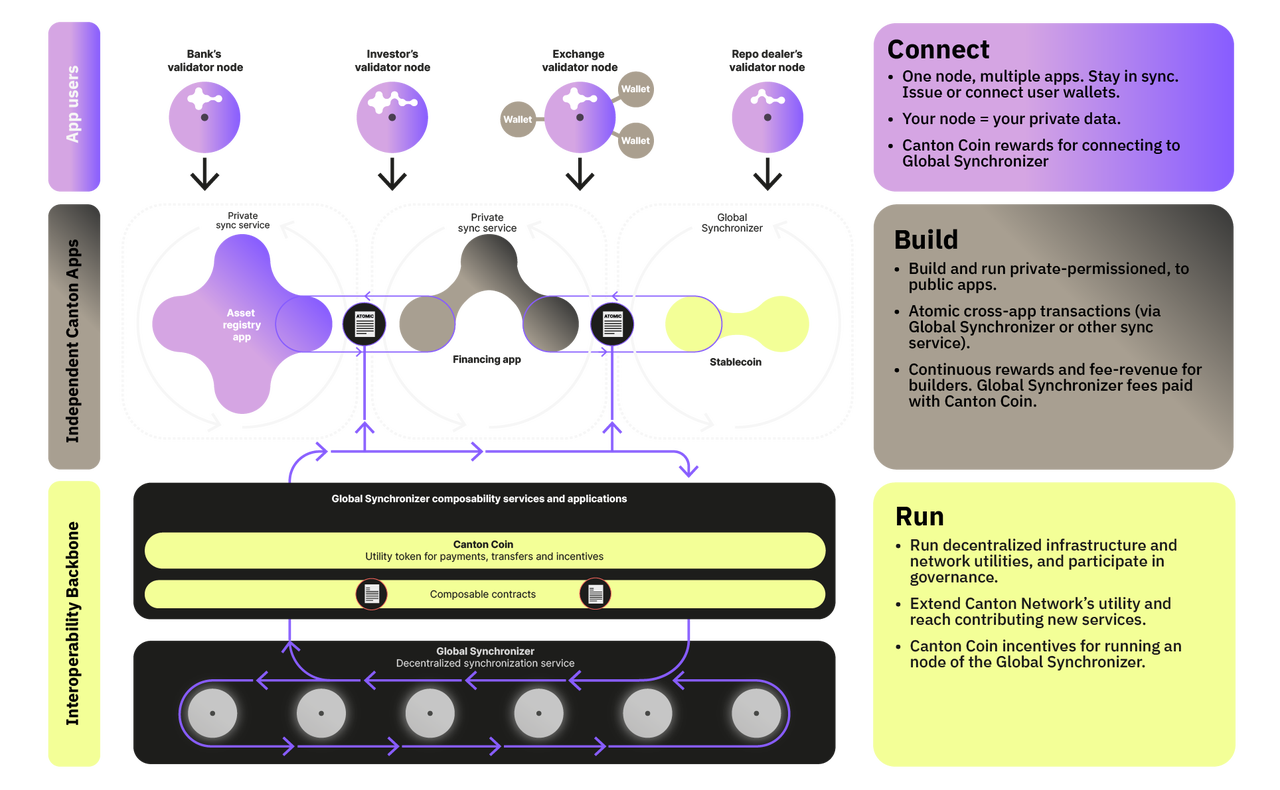
In traditional Bridge designs, different chains transfer assets via lock-and-message mechanisms. Canton, however, focuses on shared state synchronization—multiple participating systems jointly confirm whether a transaction has been successfully completed.
When a transaction occurs:
- The Participant Node submits the transaction request
- The Sequencer orders the messages
- The Mediator coordinates transaction verification
- The Global Synchronizer synchronizes the final state
This structure ensures all participants see consistent results, preventing double-spending, state conflicts, or partial transaction failures.
Because the Global Synchronizer prioritizes state coordination over simple asset movement, it is ideal for complex financial protocols and institutional settlement scenarios.
How Do Daml Smart Contracts Enable Cross-Network Collaboration?
Daml is Canton’s smart contract language, designed for multi-party collaboration and permission control.
On traditional public blockchains, smart contracts are generally executed publicly, with all nodes able to view transaction data. Daml allows developers to specify:
- Which participants can view data
- Which institutions can execute specific operations
- Which assets can be synchronized across systems
Daml can also model complex financial processes, such as digital bond issuance, multi-party payment settlement, custody and clearing workflows, and on-chain asset lifecycle management.
By integrating Daml with the Global Synchronizer, Canton enables more granular collaboration across multiple independent networks.
How Does Canton Differ From Traditional Bridges?
While both Canton and traditional Bridges enable “cross-network interaction,” their underlying logic is fundamentally different.
Traditional Bridges typically rely on:
- Locking mechanisms
- Relay verification
- Third-party Signatures
- Wrapped Assets (mapped assets)
While this model enables asset transfers, it is also a frequent target for security attacks. In recent years, many major DeFi security incidents have been linked to Bridge vulnerabilities.
In contrast, Canton emphasizes shared state synchronization, atomic settlement, multi-party consensus verification, and permissioned data sharing. Canton is not designed as a general-purpose Bridge, but as a synchronized collaboration network tailored for institutional finance.
Why Is Canton’s Interoperability Ideal for RWA?
RWA (Real World Assets) often require collaboration among issuers, custodians, banks, and regulators.
In traditional systems, these institutions operate on isolated databases, making real-time asset state synchronization challenging.
Canton’s interoperability architecture enables:
- Unified asset state
- Permissioned data sharing
- Real-time synchronized settlement
- Lower cross-institution reconciliation costs
Canton is therefore widely recognized as a leading solution for institutional-grade RWA infrastructure.
Summary
Canton’s interoperability is not just traditional “cross-chain communication”—it is a synchronized collaboration architecture purpose-built for institutional finance.
With the Global Synchronizer, Daml smart contracts, and atomic settlement mechanisms, Canton delivers data synchronization, asset collaboration, and consensus verification across diverse financial systems. As institutional finance moves on-chain and becomes programmable, interoperability is set to become a core competitive edge in next-generation financial infrastructure.
FAQs
How Does Canton’s Interoperability Differ From Traditional Bridges?
Traditional Bridges focus on asset transfers. Canton places greater emphasis on state synchronization, atomic settlement, and multi-party consensus verification.
Why Is Canton Suited for Institutional Finance?
Canton offers privacy controls, permission management, synchronized settlement, and cross-system collaboration—addressing the compliance needs of institutional finance.
How Does Daml Support Interoperability?
Daml defines data access permissions and asset logic for different participants, enabling collaborative execution of financial protocols across institutions.
Does Canton Support RWA?
Yes. Canton is widely used for digital bonds, on-chain funds, payment settlement, and other RWA scenarios.
Is Canton Fully Open and Transparent?
No. Canton uses a Sub-Transaction Privacy mechanism, sharing transaction data only with relevant participants.







