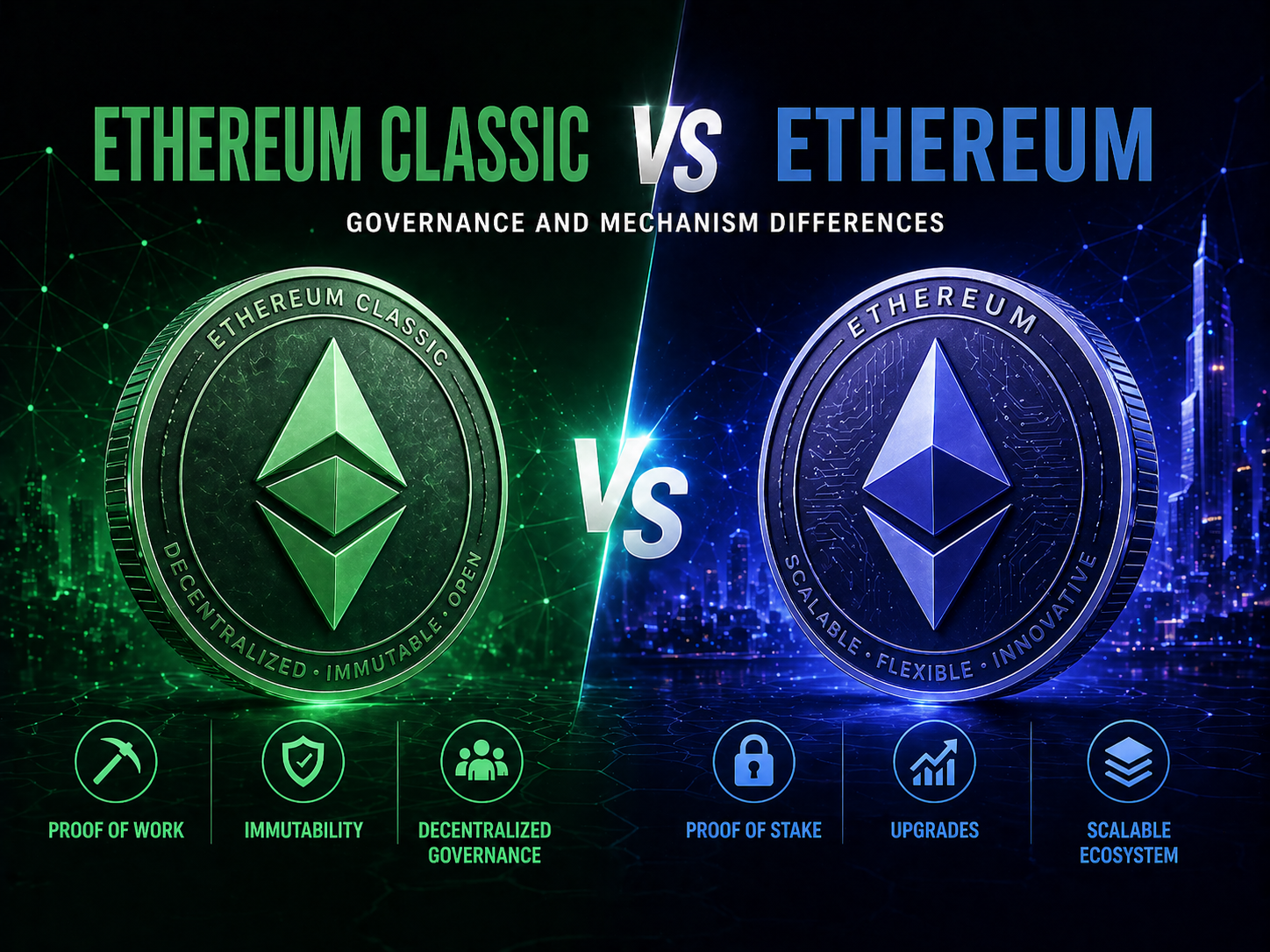
Users interested in Ethereum Classic versus Ethereum are typically drawn by their similar names and shared technical roots, yet their development paths are fundamentally different. To truly understand this distinction, one must look beyond the names ETC and ETH, and evaluate their governance philosophies, consensus mechanisms, tokenomics, upgrade strategies, and application ecosystems.
This comparison centers on key areas such as original chain versus fork, PoW versus PoS, fixed supply versus dynamic issuance, and the balance between immutability and governance-driven upgrades.
What Is ETC
ETC is the native token of the Ethereum Classic network, used for Gas fees, Smart Contract execution, and incentivizing miners to secure the network.
Ethereum Classic is best understood as the public chain that preserves the original Ethereum historical state. In the aftermath of the DAO incident, it retained the unaltered on-chain records, upholding the principles of “code is law” and data immutability.
From a technical perspective, Ethereum Classic continues to use the Proof of Work mechanism. Miners compete using hash power to generate blocks, earning ETC block rewards and trading fees. According to official sources, Ethereum Classic follows a fixed supply model, with a widely referenced maximum supply of 210.7 million ETC. Its issuance schedule is governed by the 5M20 mechanism, which reduces block rewards by 20% every 5 million blocks.
As such, ETC is not only a transaction token but also a core component for sustaining Ethereum Classic’s PoW security and fixed supply model.
What Is ETH
ETH is the native token of the Ethereum network, used for Gas fees, staking, Smart Contract execution, and network security.
Ethereum is a public chain built around Smart Contracts and decentralized applications. Unlike Ethereum Classic, Ethereum transitioned from Proof of Work to Proof of Stake after The Merge in 2022. According to the Ethereum Foundation, PoS secures the network by requiring validators to lock up ETH, which replaces the legacy mining mechanism.
ETH does not have a fixed maximum supply. Official documentation shows that the PoS system significantly reduced ETH issuance compared to the PoW era. New ETH is mainly distributed as validator rewards, while the EIP-1559 mechanism burns a portion of transaction base fees.
Therefore, ETH serves as both the operational fuel and staking asset of the Ethereum ecosystem, with its value directly linked to network activity, staking participation, and fee burning.
Architectural Differences Between Ethereum Classic and Ethereum
The architectural divergence between Ethereum Classic and Ethereum is rooted in their respective post-fork development strategies.
Ethereum Classic maintains an architecture closer to early Ethereum, running the EVM, account model, and PoW consensus. Its approach is more conservative, emphasizing protocol stability, immutable on-chain history, and a fixed monetary policy.
Ethereum, by contrast, has continuously upgraded its Smart Contract platform. After The Merge, Ethereum’s consensus layer relies on PoS for security, while the execution layer processes Smart Contracts and transactions. Scaling is further enabled via rollups, data availability solutions, and ongoing expansion efforts.
| Comparison Dimension |
Ethereum Classic |
Ethereum |
| Native Token |
ETC |
ETH |
| Consensus Mechanism |
PoW Mining |
PoS Staking |
| Maximum Supply |
~210.7 million ETC |
No fixed upper limit |
| Issuance Mechanism |
5M20 reward reduction |
Validator rewards and fee burning |
| Upgrade Path |
Conservative and stable |
Continuous upgrades and scaling |
| Core Positioning |
Immutable original chain |
Mainstream Smart Contract ecosystem |
In essence, Ethereum Classic prioritizes rule stability, while Ethereum focuses on upgradability and ecosystem expansion. Their architectural differences reflect divergent governance philosophies and technical strategies.
Consensus Mechanism Differences
The most fundamental distinction is that Ethereum Classic uses PoW, while Ethereum uses PoS.
On Ethereum Classic, miners compete with hash power to produce new blocks. PoW security is derived from hash power costs—an attacker must control a majority of hash power to compromise the network. ETC block rewards decrease by 20% every 5 million blocks under the 5M20 rule, aligning miner incentives with the fixed supply model.
On Ethereum, validators participate in consensus by staking ETH. PoS replaces mining hardware with a system of staking, rewards, and penalties to govern validator behavior. According to official documentation, after the PoS transition, Ethereum no longer relies on PoW mining and has dramatically reduced energy consumption.
These differences shape each chain’s security model: ETC depends on hash power and miner incentives, while ETH relies on staked capital and validator penalties. The former aligns with Bitcoin’s security approach; the latter supports Ethereum’s scaling and staking ecosystem.
Governance Philosophy and Community Divergence
The split between Ethereum Classic and Ethereum fundamentally stems from differing views on on-chain immutability and the limits of community governance.
Ethereum Classic upholds the “code is law” principle, insisting that once on-chain states are recorded, they should not be rolled back by human intervention. This philosophy emphasizes protocol neutrality—regardless of participant expectations, on-chain history must be preserved.
Ethereum, on the other hand, opts for intervention and upgrades through community consensus. After the DAO incident, the Ethereum community supported a fork to reverse the event’s on-chain consequences, and has since advanced protocol evolution through EIPs, developer meetings, and collaborative governance.
Neither governance model is inherently superior—they simply represent two blockchain value paradigms. Ethereum Classic prioritizes immutable rule boundaries, while Ethereum emphasizes ecosystem growth and protocol adaptability.
This divergence has led to different long-term trajectories: ETC as a rule-conservative public chain, and ETH as a continuously evolving Smart Contract platform.
Data Immutability and Upgrade Strategy Differences
Ethereum Classic and Ethereum differ in their interpretation of “immutability,” which drives their respective upgrade strategies.
For Ethereum Classic, immutability is a core principle. Technical upgrades are cautious, with a focus on preserving on-chain historical consistency and protocol stability. Once data is confirmed on-chain, it should remain unchanged by governance.
Ethereum also values immutability but places greater emphasis on social consensus and upgradeability. The network has undergone multiple enhancements to improve performance, security, and fee mechanisms—such as The Merge’s shift to PoS and subsequent scaling initiatives.
This contrast is a trade-off between rule stability and system evolution. Ethereum Classic prioritizes historical integrity, while Ethereum prioritizes long-term network adaptability.
For developers and users, Ethereum Classic is suited to scenarios that demand stable rules and immutable records, while Ethereum is ideal for applications that require rapid innovation and a rich ecosystem.
Application Ecosystem and Development Path Comparison
Both Ethereum Classic and Ethereum support the EVM and Smart Contracts, but their ecosystem scale and development directions differ significantly.
Ethereum boasts one of the largest Smart Contract ecosystems, spanning DeFi, NFT, DAO, stablecoins, Layer 2, and infrastructure tools. Its developer community, application count, and liquidity are unmatched, making it the platform of choice for complex and large-scale protocols.
Ethereum Classic also supports Smart Contracts, but its ecosystem is smaller, with less application activity and developer resources. Its strength lies in its commitment to PoW, robust security, and immutability.
Development-wise, Ethereum is moving toward modularity, Layer 2, and PoS-driven economics, while Ethereum Classic remains a conservative PoW chain, focusing on fixed supply, miner security, and rule stability.
Thus, ETH is primarily an application ecosystem asset, while ETC is positioned as a PoW chain asset. They share a common origin, but now serve distinct communities and value propositions.
Summary
Ethereum Classic and Ethereum began from the same origin but diverged after the DAO incident. Ethereum Classic remains committed to PoW, fixed supply, and immutability, with a commonly referenced maximum ETC supply of about 210.7 million. Ethereum shifted to PoS, has no fixed maximum supply, and utilizes staking rewards and fee burning for a dynamic monetary model. Understanding their differences requires analyzing governance philosophy, consensus mechanisms, tokenomics, and ecosystem development—not simply comparing ETC and ETH prices.
FAQ
What is the biggest difference between Ethereum Classic and Ethereum
Ethereum Classic is committed to PoW and immutability, while Ethereum has transitioned to PoS and continues to upgrade its protocol. Both originated from the same early Ethereum chain, but diverged in governance philosophy and technical direction.
How does the total token supply differ between ETC and ETH
ETC follows a fixed supply model, with a widely cited maximum of about 210.7 million. ETH has no fixed maximum supply; its supply is determined by staking rewards, network activity, and fee burning.
Can Ethereum Classic still be mined
Yes. Ethereum Classic still uses the PoW mechanism. Miners participate in block production using the ETChash algorithm and earn ETC block rewards and trading fees.
Why doesn’t Ethereum use PoW anymore
After The Merge in 2022, Ethereum switched to PoS. Official sources state that PoS significantly reduces energy consumption and better supports future scaling and validator security.
Which ecosystem is larger, Ethereum Classic or Ethereum
Ethereum’s ecosystem is substantially larger, encompassing a wide range of applications including DeFi, NFT, Layer 2, and stablecoins. The Ethereum Classic ecosystem is smaller, with greater emphasis on PoW, security, and immutability.







