As blockchain technology expands beyond digital assets into supply chain management, data collaboration, and enterprise services, an increasing number of companies are seeking to leverage blockchain for enhanced data transparency and business collaboration efficiency. However, most enterprises face significant hurdles in directly deploying blockchain infrastructure due to high technical complexity, elevated costs, and lengthy implementation timelines. As a result, ecosystems offering comprehensive tools and infrastructure support have become critical.
VeChain is designed to address this need. By combining its foundational blockchain network, dual-token economic model, and enterprise-focused ToolChain service platform, VeChain delivers a robust blockchain solution for businesses. Unlike public chain projects that only offer base-level protocols, VeChain prioritizes tool usability and real-world enterprise adoption, making it particularly important in the enterprise blockchain landscape.
What are the components of the VeChain ecosystem?
The VeChain ecosystem is comprised of four core elements: the VeChainThor blockchain network, dual-token mechanism, ToolChain enterprise platform, and partner network.
VeChainThor serves as the foundational blockchain infrastructure, handling transactions, executing Smart Contracts, and recording on-chain data. The dual-token mechanism—featuring VET and VTHO—facilitates value transfer and trading fee payments. ToolChain provides enterprise-grade application interfaces and services, while the partner network drives VeChain adoption across a variety of industry use cases.
Together, these components form VeChain’s enterprise blockchain ecosystem, enabling businesses to access end-to-end support from infrastructure to application services.
What role does VeChainThor play in the ecosystem?
VeChainThor functions as the underlying blockchain network for the VeChain ecosystem, acting as its infrastructure layer.
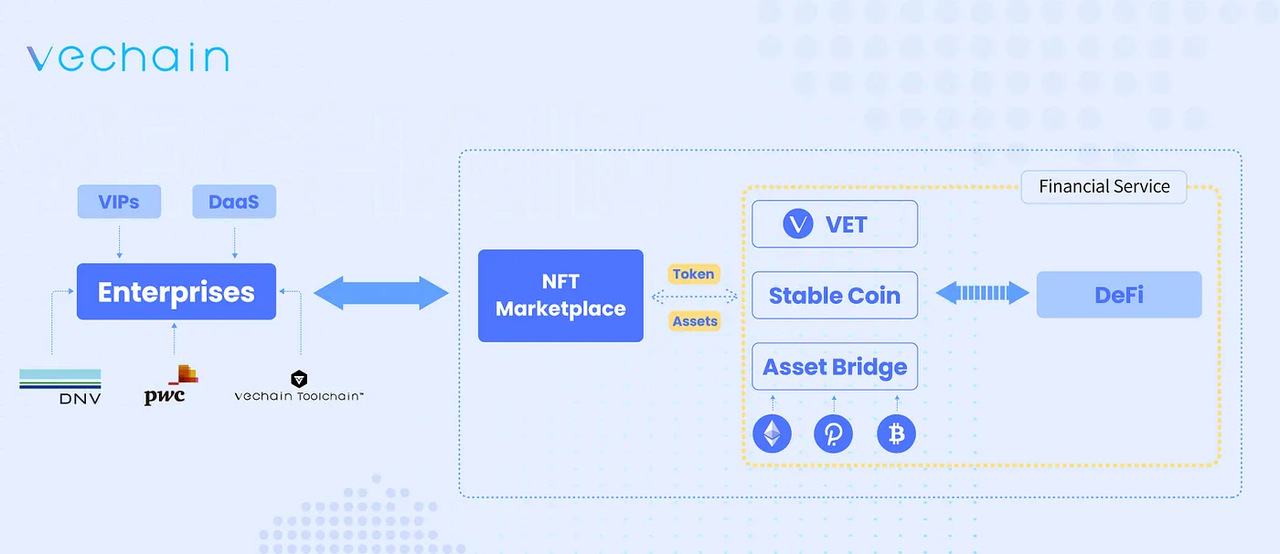
It is responsible for recording trading data, executing Smart Contracts, and maintaining ledger consistency. Enterprise applications for supply chain tracking, anti-counterfeiting, and data sharing deployed on VeChain all rely on VeChainThor for foundational support.
Thanks to its PoA consensus mechanism, VeChainThor delivers high transaction throughput and low on-chain costs, making it well-suited for high-frequency enterprise data recording scenarios.
What is the function of the dual-token mechanism in the VeChain ecosystem?
VeChain’s VET + VTHO dual-token model is a cornerstone of its ecosystem.
VET is the primary value token, used for value transfer and network governance, while VTHO is a utility token for paying on-chain trading fees.
By separating value storage from network usage costs, this mechanism gives enterprises a more stable cost structure when using blockchain services. This design is especially beneficial for companies that require frequent on-chain data recording, as it helps reduce operational cost uncertainty caused by token price volatility.
ToolChain is VeChain’s all-in-one blockchain service platform for enterprises, designed to enable rapid deployment of blockchain applications. With ToolChain, businesses can record product information, logistics data, and asset records on the blockchain without developing complex on-chain infrastructure themselves. This significantly lowers the technical barrier for blockchain integration, making it easier for traditional enterprises to adopt blockchain solutions.
From a functional perspective, ToolChain is VeChain’s enterprise application gateway, serving as a critical bridge between core blockchain capabilities and real-world business needs.
ToolChain empowers enterprises to deploy blockchain applications in diverse business scenarios through modular services.
For instance, in product traceability, companies can use ToolChain to create unique on-chain records for goods and continuously update data throughout production, transport, and sales. In anti-counterfeiting, consumers can verify authenticity by scanning product information. In carbon emission management, companies can record and track environmental data.
By offering standardized interfaces and preconfigured modules, ToolChain shortens the time required for blockchain solution deployment and reduces implementation complexity for enterprises.
What is the role of VeChain’s partner ecosystem?
The partner ecosystem is a key driver of VeChain’s real-world adoption.
By collaborating with enterprises, technology providers, and industry partners, VeChain integrates blockchain capabilities into supply chain, logistics, sustainability, and digital certification scenarios. These partnerships not only broaden VeChain’s application scope but also enhance the practical value of its ecosystem.
For enterprise blockchain initiatives, ecosystem collaboration is often the deciding factor in real-world adoption depth, making the partner network a strategic asset for VeChain.
What are the advantages of the VeChain ecosystem?
VeChain’s primary advantages are completeness, ease of use, and scenario adaptability.
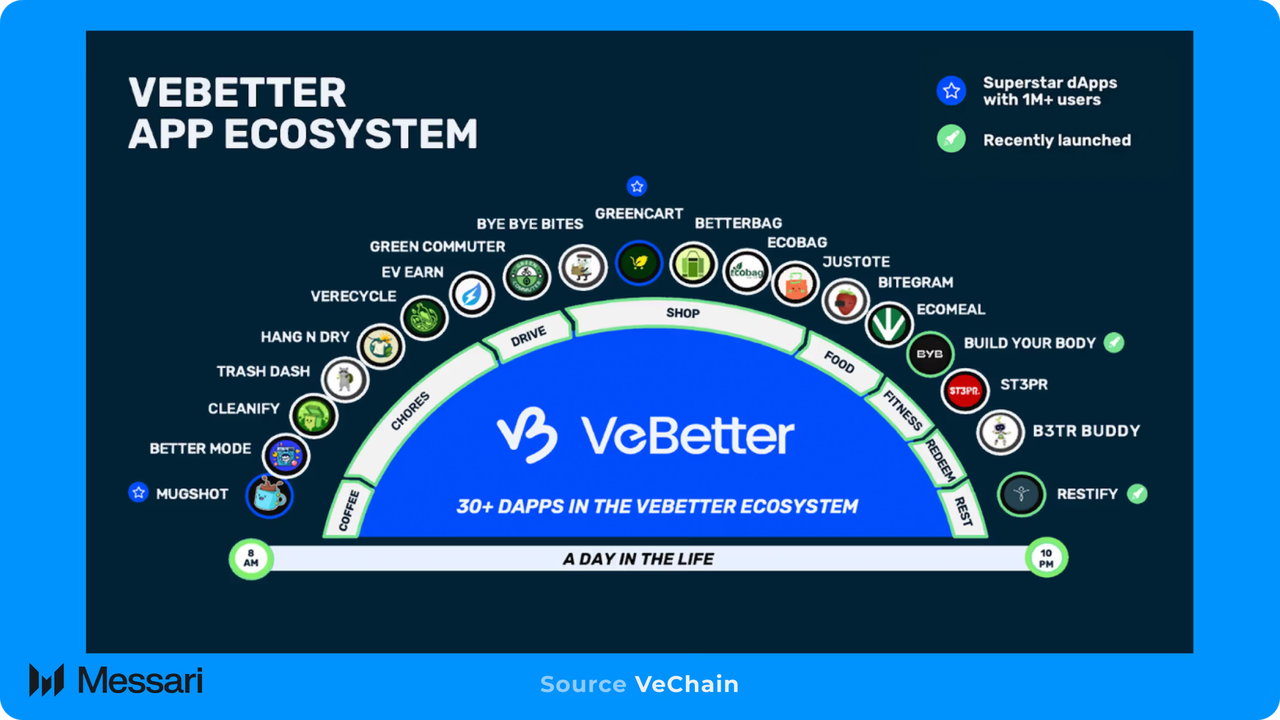
Completeness is reflected in its end-to-end architecture, from the core network to application tools. Ease of use is demonstrated by ToolChain’s ability to lower the entry barrier for businesses, while scenario adaptability is evident in VeChain’s focus on supply chain and enterprise service requirements.
This comprehensive design—from infrastructure to application services—positions VeChain as more than just a blockchain network; it is a solution platform ready for direct integration into enterprise business processes.
What challenges does the VeChain ecosystem face?
Despite its strong enterprise fit, the VeChain ecosystem faces several challenges.
First, enterprise blockchain adoption cycles are lengthy, and business process integration is complex, which can slow ecosystem expansion. Second, VeChain’s application scenarios are primarily concentrated in supply chain and enterprise services, and its developer ecosystem is less extensive than general-purpose public chains. Lastly, while the PoA consensus model boosts efficiency, it also reduces the level of network decentralization.
These factors give VeChain an edge in enterprise blockchain, but ongoing development is needed to broaden its open ecosystem.
Summary
The VeChain ecosystem—comprising the VeChainThor blockchain network, dual-token mechanism, ToolChain platform, and partner ecosystem—delivers a complete blockchain solution for enterprises, from foundational infrastructure to business application support.
ToolChain, as the enterprise service gateway, significantly lowers the barrier to blockchain deployment, enabling VeChain to drive real-world adoption in supply chain tracking, anti-counterfeiting, and sustainability. Through this enterprise-focused ecosystem structure, VeChain has carved out a unique position in the enterprise blockchain space.
FAQs
What are the core components of the VeChain ecosystem?
The VeChain ecosystem includes the VeChainThor blockchain network, VET and VTHO dual-token mechanism, ToolChain enterprise platform, and partner network.
What is the main function of VeChainThor?
VeChainThor is VeChain’s core blockchain network, responsible for processing transactions, executing Smart Contracts, and recording on-chain data.
Why is VeChain suitable for enterprise applications?
VeChain offers a low-cost, high-efficiency core network and, through ToolChain, lowers the technical barrier for enterprise blockchain adoption.
What are the main challenges of the VeChain ecosystem?
Key challenges include long enterprise adoption cycles, a relatively narrow range of application scenarios, and reduced decentralization under the PoA model.







