As decentralized infrastructure continues to expand, network bandwidth is gradually becoming a digital resource that can be shared and incentivized. Traditional network access services usually rely on centralized proxy nodes for bandwidth support, but this model has issues such as resource concentration, higher costs, and limited transparency.
As demand for distributed network resources grows, bandwidth sharing protocols are beginning to use incentive mechanisms to connect idle resource providers with network demand parties, allowing personal network resources to participate in decentralized network service supply. Grass and Nodepay are representative bandwidth sharing protocols that have emerged in this context.
Introduction to Grass and Nodepay, and a Comparison of Their Core Differences
As a decentralized bandwidth sharing protocol, Grass users mainly run nodes to share idle network resources, providing bandwidth support for distributed network access and receiving points rewards based on resource contribution. Its core goal is to build a decentralized network access layer made up of user nodes, enabling public web requests to be executed through global nodes instead of relying on centralized proxy services.
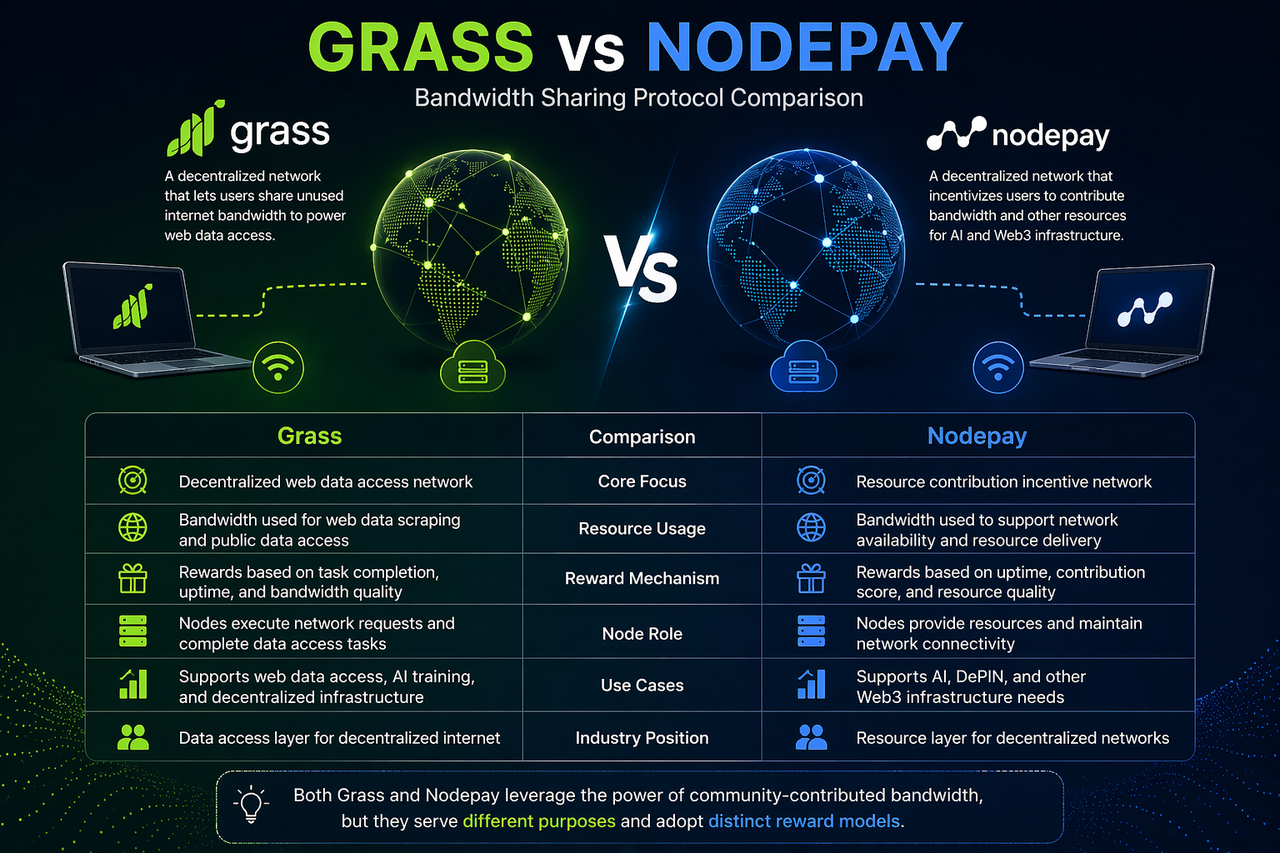
Nodepay is also a decentralized protocol based on resource sharing. Users contribute network resources by running nodes and receive rewards based on node status and resource contribution. Similar to Grass, Nodepay incorporates users’ idle network resources into its protocol operations. However, its focus is not on executing specific network access tasks, but on building a clear relationship between resource contribution and rewards.
For this reason, Nodepay’s core value leans more toward the resource contribution network itself. It builds a resource incentive system around node online status, stability, and resource availability, making node contribution behavior the main source of value within the protocol.
| Comparison Dimension |
Grass |
Nodepay |
| Core Positioning |
Decentralized data access network |
Decentralized resource contribution network |
| Resource Use |
Public internet access and data requests |
Node resource contribution |
| Reward Logic |
Rewards based on task contribution |
Rewards based on node contribution |
| Node Role |
Executes network tasks |
Provides resource online status |
| Network Goal |
Provides distributed access capacity |
Builds a resource incentive system |
| Application Direction |
Data scraping and network access |
Resource supply and contribution incentives |
How Do the Protocol Goals of Grass and Nodepay Differ?
Although Grass and Nodepay both use users’ idle network resources, their protocol goals are not the same. Grass’s core goal is to build a decentralized data access network. It places greater emphasis on how these network resources are used to execute real tasks, such as supporting public data access requests and network traffic distribution. As a result, Grass is closer to bandwidth infrastructure designed for network task execution.
By contrast, Nodepay focuses more on the act of resource contribution itself. Its core goal is to use incentives to attract users to keep contributing resources, forming a scalable resource supply network. In this sense, Nodepay is closer to a node incentive protocol built around resource supply.
This difference means Grass places more emphasis on resource use efficiency, while Nodepay places more emphasis on resource supply incentives.
How Do Grass and Nodepay Use Resources Differently?
In terms of resource use, Grass mainly uses shared user bandwidth to execute public web access tasks. When a data access request appears in the network, the protocol distributes the task to nodes for execution, and the nodes perform the actual data access function. Therefore, the resource contribution of Grass nodes is directly tied to specific tasks.
Nodepay’s resource use is more focused on recording node contribution. Node resources are mainly used to maintain resource supply capacity within the protocol and do not necessarily carry out clearly defined data access tasks. The protocol focuses on measuring node online status and resource availability, then builds its reward logic around those factors.
This means Grass’s resource use is task driven, while Nodepay’s resource use is contribution driven.
How Do the Reward Models of Grass and Nodepay Differ?
Grass’s reward mechanism is closely tied to the actual tasks completed by nodes. The longer a node stays online, the higher its bandwidth quality, and the more network tasks it completes, the more points it will usually receive. This reward mechanism directly links node earnings with real network contribution and emphasizes the importance of task execution efficiency.
Nodepay’s reward mechanism focuses more on the degree of node resource contribution. Rewards are usually distributed based on node online status, resource stability, and contribution level, rather than the number of specific tasks completed. As a result, it places more emphasis on the ability to continuously provide resources, rather than task execution efficiency.
From an incentive perspective, Grass is closer to a task reward mechanism, while Nodepay is closer to a resource participation reward mechanism.
How Do the Network Structures of Grass and Nodepay Differ?
Grass’s network structure is built around task distribution. After the protocol receives a network request, it assigns the task to eligible nodes for execution, so nodes in the Grass network serve as task executors. This structure makes Grass more like a decentralized network access layer.
Nodepay’s network structure is more focused on resource node management. A node’s main role is to remain online and provide resource availability. The protocol rewards nodes based on their performance and does not necessarily involve complex task scheduling. For this reason, Nodepay is closer to a resource incentive network.
Simply put, Grass nodes are execution based nodes, while Nodepay nodes are contribution based nodes.
How Do the Application Scenarios of Grass and Nodepay Differ?
Because their network design goals differ, Grass and Nodepay also have different application scenarios. Grass is better suited to scenarios that require large scale distributed network access capacity, such as public data scraping, network request distribution, and decentralized data access services. These scenarios require nodes to actually process network requests, so they depend more heavily on task execution capability.
Nodepay is more suited to resource contribution incentive scenarios. Its focus is on building a node resource supply network so that resource contribution behavior can be continuously incentivized. This type of protocol cares more about the stability and scalability of the resource network than about specific data access needs.
As a result, Grass leans toward a functional bandwidth network, while Nodepay leans toward a resource based node network.
Conclusion
Although Grass and Nodepay are both bandwidth sharing protocols and both build reward mechanisms through users’ contributions of idle network resources, their design goals are clearly different. Grass focuses more on applying bandwidth resources to real network tasks, using a task distribution mechanism to build a decentralized data access network. Nodepay focuses more on resource contribution itself, building a resource incentive system around node online status and resource quality.
This difference reflects two development paths for bandwidth sharing protocols: one builds network infrastructure around task execution, while the other builds an incentive network around resource contribution. Understanding this distinction helps provide a more systematic view of how decentralized bandwidth protocols are designed.
FAQs
What Is the Main Difference Between Grass and Nodepay?
Grass focuses more on using shared bandwidth to execute network tasks, while Nodepay focuses more on building a reward mechanism around node resource contribution. As a result, the two differ clearly in resource use and incentive logic.
Is Grass’s Reward Mechanism the Same as Nodepay’s?
Both reward users for node contribution, but Grass places more emphasis on task completion volume, while Nodepay places more emphasis on node online status and degree of resource contribution.
What Application Scenarios Is Grass Better Suited For?
Grass is better suited to scenarios that require distributed network access capacity, such as public data access, network request distribution, and decentralized data access infrastructure.
What Is Nodepay’s Core Goal?
Nodepay’s core goal is to build a resource contribution incentive network, using node resource supply and reward mechanisms to form a sustainable resource network.
Why Are Grass and Nodepay Often Compared?
They are often compared because both use bandwidth sharing and node incentive models, but they differ in resource use and protocol goals.







