Yunna

vip
Age 0.4 Year
Peak Tier 5
No content yet
#GateSquareMayTradingShare
May 2026 represents a critical phase for crypto markets as shifting liquidity conditions, institutional participation, and macroeconomic uncertainty continue to shape overall market behavior. Bitcoin remains a central focus as ETF inflows continue to support sustained demand from institutional investors. This ongoing capital rotation into BTC reflects increasing confidence in digital assets as a long-term macro instrument rather than purely speculative exposure.
Ethereum is also showing early signs of strategic accumulation, with market participants gradually positi
BTC-0.16%
ETH-1.41%
MrFlower_XingChen
#GateSquareMayTradingShare
May 2026 represents a critical phase for crypto markets as shifting liquidity conditions, institutional participation, and macroeconomic uncertainty continue to shape overall market behavior. Bitcoin remains a central focus as ETF inflows continue to support sustained demand from institutional investors. This ongoing capital rotation into BTC reflects increasing confidence in digital assets as a long-term macro instrument rather than purely speculative exposure.
Ethereum is also showing early signs of strategic accumulation, with market participants gradually positioning ahead of potential ecosystem developments and network upgrades. This type of behavior often indicates that sophisticated investors are preparing for future volatility expansion phases, where pricing efficiency and network utility improvements can significantly impact valuation.
At the macro level, global financial conditions remain highly dynamic. Central bank policy expectations, inflation trends, and liquidity cycles continue to influence risk appetite across all asset classes. In this environment, crypto markets are behaving as a highly liquidity-sensitive sector, reacting quickly to changes in capital flow expectations and broader market sentiment.
Despite this uncertainty, the overall structure of the crypto market remains intact, with periodic volatility being absorbed through consolidation phases rather than breakdowns. These consolidation periods are essential for market stability, as they allow leverage to reset, liquidity to redistribute, and stronger hands to accumulate positions at more efficient price levels.
From a trading perspective, the focus this month is on disciplined execution rather than prediction. The key principles remain consistent: patience during sideways or uncertain phases, strict risk management through controlled position sizing, and readiness to act when breakout conditions are confirmed by volume and structural alignment in BTC and ETH.
Bitcoin and Ethereum continue to act as primary market indicators, and their behavior often sets the tone for broader altcoin movement. When volume expansion aligns with directional structure, it typically signals the beginning of stronger trend phases, making confirmation more important than anticipation.
Ultimately, successful trading is not defined by constant accuracy, but by the ability to preserve capital during uncertain conditions and capitalize effectively when clear opportunities emerge. May requires a balanced approach—combining patience, discipline, and responsiveness to market structure as conditions evolve.
#Gate13thAnniversaryLive
#GateSquareMayTradingShare
#TopCopyTradingScout

repost-content-media
  • Reward
  • 8
  • Repost
  • Share
Crypto_Buzz_with_Alex:
LFG 🔥
View More
#GateSquareMayTradingShare
BTC moved back near $81K after weeks of sharp swings. Earlier this year, price kept losing grip around $70K, turning this level into a key clash area for buyers and sellers.
The push above $70K came mostly from futures-driven moves instead of strong spot buying. Huge short squeezes forced quick price jumps, while heavy leverage led to fast pullbacks soon after. This kept risk levels high across the crypto space.
Global pressure also hurt risk assets. Rising yields, policy fears, plus energy-linked worries reduced trader confidence. During this phase, BTC held up bet
BTC-0.16%
MrFlower_XingChen
#GateSquareMayTradingShare
BTC moved back near $81K after weeks of sharp swings. Earlier this year, price kept losing grip around $70K, turning this level into a key clash area for buyers and sellers.
The push above $70K came mostly from futures-driven moves instead of strong spot buying. Huge short squeezes forced quick price jumps, while heavy leverage led to fast pullbacks soon after. This kept risk levels high across the crypto space.
Global pressure also hurt risk assets. Rising yields, policy fears, plus energy-linked worries reduced trader confidence. During this phase, BTC held up better than most altcoins, while many smaller coins saw deep drops.
Big ETF inflows helped give BTC solid support near the mid-$60K area. This steady buying later helped price climb back toward the $81K range.
Key price levels:
• $80.6K first support
• $84K key upside level
• $70K–$72K major long-term support
#Gate13thAnniversaryLive
#TopCopyTradingScout
#WCTCTradingKingPK
repost-content-media
  • Reward
  • 7
  • Repost
  • Share
Crypto_Buzz_with_Alex:
LFG 🔥
View More
Ethereum is trading near $2,377 with modest gains, reflecting a market in transition. Strong institutional inflows, rising staking activity, and upcoming upgrades like Glamsterdam and Pectra support long-term growth and scalability. However, macro uncertainty, weak momentum near the $2,360–$2,400 resistance zone, and mixed derivatives sentiment limit upside. Overall, sentiment remains cautiously optimistic as ETH balances structural strength against short-term pressure.
ETH-1.41%
MrFlower_XingChen
ETH Near-Term Catalysts Overview
Ethereum is trading near $2,377 with modest gains, reflecting a market in transition. Strong institutional inflows, rising staking activity, and upcoming upgrades like Glamsterdam and Pectra support long-term growth and scalability. However, macro uncertainty, weak momentum near the $2,360–$2,400 resistance zone, and mixed derivatives sentiment limit upside. Overall, sentiment remains cautiously optimistic as ETH balances structural strength against short-term pressure.
  • Reward
  • 7
  • Repost
  • Share
Crypto_Buzz_with_Alex:
2026 GOGOGO 👊
View More
#WCTCTradingKingPK
In today’s hyper-competitive crypto environment, is more than a trend—it represents a new standard of trading excellence, where success is defined not by a single winning trade, but by consistent performance under extreme pressure, intelligent risk control, and the ability to adapt faster than the market itself.
Trading competitions like WCTC have evolved into high-speed simulations of real market chaos, compressing months of volatility into days. This creates a battlefield where traders are forced to operate with maximum efficiency, minimal error tolerance, and complete em
CryptoDiscovery
#WCTCTradingKingPK
In today’s hyper-competitive crypto environment, is more than a trend—it represents a new standard of trading excellence, where success is defined not by a single winning trade, but by consistent performance under extreme pressure, intelligent risk control, and the ability to adapt faster than the market itself.
Trading competitions like WCTC have evolved into high-speed simulations of real market chaos, compressing months of volatility into days. This creates a battlefield where traders are forced to operate with maximum efficiency, minimal error tolerance, and complete emotional discipline. In such an environment, randomness disappears quickly—and only structured traders survive.
🧠 The Mindset Shift: From Trader to System Builder
Most participants approach competitions with a trader mindset:
👉 Find opportunities
👉 Take trades
👉 Chase profits
But top performers operate differently.
They think like system builders:
- Every trade follows a predefined rule
- Every risk is calculated before entry
- Every outcome is part of a larger framework
Because in competitive trading, your system matters more than your signals.
Performance Is Not Profit—It’s Stability
One of the biggest misconceptions is that the highest profit equals the best trader.
In reality, professionals measure:
- Drawdown consistency → how controlled losses are
- Equity curve stability → smooth growth vs volatility
- Risk-adjusted returns → efficiency, not size
- Behavior under stress → discipline during losing streaks
A trader who grows steadily with low drawdown will often outperform one who spikes quickly and crashes.
The Leverage Trap Everyone Falls Into
Competitions create pressure to climb the leaderboard fast.
This leads to:
- Over-leveraging
- Overtrading
- Emotional decision-making
But leverage is not an advantage—it’s a multiplier of mistakes.
A true Trading King:
- Uses leverage selectively
- Reduces exposure during uncertainty
- Increases size only after confirmation
Adapting to Market Regimes
Markets constantly shift between:
- Trend expansion
- Sideways consolidation
- Volatility spikes
- Liquidity-driven reversals
A static strategy fails in these conditions.
Winning traders:
- Switch between scalping and swing strategies
- Reduce trading frequency in unclear markets
- Increase aggression only when structure is clean
Adaptability becomes the ultimate edge.
The Hidden Game: Liquidity Hunting
Advanced traders understand that markets move toward liquidity zones:
- Stop-loss clusters
- Liquidation levels
- High-volume entry areas
Instead of reacting to price, they anticipate:
👉 Where the market is likely to go to “take liquidity”
This allows them to:
- Enter before major moves
- Avoid traps
- Exit before reversals
💰 Capital Management = Survival Strategy
In WCTC, survival is everything.
A strong framework includes:
- Fixed risk per trade
- Maximum daily loss limits
- Gradual scaling of positions
- Profit protection mechanisms
Because once capital is lost, opportunity is gone.
🚀 Personal Execution Approach
My approach in this environment is simple:
- I don’t chase the leaderboard
- I focus on high-quality setups only
- I stay patient during unclear conditions
- I scale when confirmation aligns
- I protect capital above all
Because consistency compounds—while mistakes compound faster.
🔥 Final Insight is not about being the fastest or most aggressive trader.
It is about being the most controlled, disciplined, and strategically aware participant in the market.
In competitive trading:
Speed creates opportunity
Skill generates profit
But discipline sustains success
And in the end, the real Trading King is not the one who wins quickly—
It is the one who never loses control of the system they trade.
#GateSquareMayTradingShare #GateSquare #CreatorCarnival #ContentMining
repost-content-media
  • Reward
  • 9
  • Repost
  • Share
Crypto_Buzz_with_Alex:
LFG 🔥
View More
#Gate广场五月交易分享
Global Market Structure Update — Liquidity Cycles, Institutional Positioning, and the Next Phase of Crypto Expansion
The current financial environment is transitioning through a critical macro phase where liquidity, derivatives positioning, and institutional capital flows are becoming more dominant than traditional retail-driven price action. Across Bitcoin, Ethereum, and major altcoins, the market is showing signs of structural compression — a phase that often precedes significant directional expansion.
This is not a random market environment. It is a structured system reacting
BTC-0.16%
ETH-1.41%
CryptoDiscovery
#Gate广场五月交易分享
Global Market Structure Update — Liquidity Cycles, Institutional Positioning, and the Next Phase of Crypto Expansion
The current financial environment is transitioning through a critical macro phase where liquidity, derivatives positioning, and institutional capital flows are becoming more dominant than traditional retail-driven price action. Across Bitcoin, Ethereum, and major altcoins, the market is showing signs of structural compression — a phase that often precedes significant directional expansion.
This is not a random market environment. It is a structured system reacting to global liquidity conditions, interest rate expectations, and evolving risk appetite across institutions.
Macro Liquidity Conditions — The Real Market Driver
At the core of all price movements is liquidity. When global liquidity expands, risk assets tend to perform strongly. When liquidity tightens, markets enter consolidation or correction phases.
Currently, the market is operating in a mixed liquidity environment:
– Central banks remain cautious on rate cuts
– Treasury yields remain elevated in historical context
– Institutional capital is selective rather than aggressive
– ETF inflows provide structural support but not exponential expansion
This creates a balanced but compressed market structure.
Compression means energy is building, not disappearing.
Bitcoin Market Structure — Controlled Equilibrium Phase
Bitcoin is currently positioned in a macro equilibrium zone where neither buyers nor sellers have full control. Price action reflects:
– Repeated testing of key psychological levels
– Absorption of liquidity on both sides
– Reduced volatility compared to expansion phases
– Increasing influence of derivatives positioning
In such environments, Bitcoin often behaves less like a speculative asset and more like a structured financial instrument influenced by:
– Options positioning
– ETF flows
– Institutional hedging activity
– Macro sentiment shifts
This is a key transformation in its market identity.
Ethereum and Altcoin Behavior — Beta Compression Effect
Ethereum and altcoins are currently showing beta compression relative to Bitcoin.
This means:
– ETH follows BTC direction but with amplified volatility
– Altcoins lag in recovery phases
– Liquidity rotates selectively rather than broadly
– Only strong narrative-driven assets outperform
This structure typically appears before a broader market rotation phase.
When liquidity returns, altcoins often outperform aggressively — but only after Bitcoin stabilizes first.
Derivatives Market Influence — Hidden Price Engine
One of the most important structural changes in modern crypto markets is the dominance of derivatives over spot trading.
Key dynamics include:
– Options positioning creating price magnets
– Futures funding rates influencing momentum
– Liquidation clusters driving sharp moves
– Market maker hedging shaping intraday volatility
This means price is increasingly influenced by positioning rather than pure demand.
In simple terms:
The market moves where liquidity is needed, not where sentiment expects.
Liquidity Zones — The Invisible Battlefield
Every major asset is currently sitting between liquidity clusters.
Above current levels:
– Short positions waiting for breakout confirmation
– Stop losses from breakout traders
– Momentum chasing orders
Below current levels:
– Long positions with leveraged exposure
– Panic exit zones from weak hands
– Accumulation interest from stronger participants
This dual liquidity structure often leads to:
– False breakouts
– Liquidity sweeps
– Sharp reversals
– Range expansion after consolidation
Market behavior is engineered around liquidity, not randomness.
Institutional Behavior — Strategic Accumulation Phase
Institutional participants are not driven by short-term volatility. Their behavior is structured and cyclical:
– Accumulate during low volatility phases
– Hedge during uncertainty phases
– Distribute during euphoric phases
– Reposition based on macro cycles
Currently, behavior suggests:
– Selective accumulation in Bitcoin
– Hedging in derivatives markets
– Cautious exposure in altcoins
– Preference for structured products like ETFs
This indicates a long-term positioning phase rather than a distribution phase.
Psychological Market Conditions — Emotional Compression
Retail trader behavior plays a major role in liquidity cycles.
In the current environment:
– Low volatility reduces confidence
– False moves increase emotional trading
– Patience decreases among short-term participants
– Overtrading becomes more common
This leads to inefficient decision-making, which larger players often exploit.
Markets are not only technical systems — they are psychological systems.
Macro Catalysts Ahead — What Could Break Compression
The current structure is waiting for catalysts that can trigger directional expansion. These include:
– Inflation data surprises (CPI/PCE)
– Central bank policy shifts or rate cut signals
– ETF inflow acceleration or slowdown
– Geopolitical risk expansion or de-escalation
– Liquidity injections or tightening signals
Any of these factors can act as a trigger for volatility expansion.
Compression always resolves — it does not remain permanent.
Volatility Cycle — Expansion Follows Compression
Market cycles typically follow a repeating structure:
1. Expansion phase (strong trend movement)
2. Distribution phase (profit taking and positioning shift)
3. Compression phase (low volatility, uncertainty)
4. Expansion phase (next directional breakout)
The current phase is clearly aligned with compression.
Historically, this phase precedes strong directional moves.
Risk Environment — What Traders Must Understand
In compressed markets, risk increases not because of direction, but because of unpredictability.
Key risks include:
– Sudden liquidity sweeps
– Fake breakouts
– Rapid reversals
– Overleveraged positioning traps
Proper risk management becomes more important than prediction.
Survival in this phase depends on discipline, not aggression.
Final Structural Insight
The current Gate Square May Trading environment reflects a global market in transition — where liquidity is stabilizing, volatility is compressed, and institutional positioning is quietly building beneath the surface.
This is not a breakout phase yet.
It is a preparation phase.
And in financial markets, preparation phases are often followed by the most significant expansion moves.
Final Thought
Markets do not reward impatience.
They reward positioning before expansion, not reaction after movement.
The real opportunity is not in chasing volatility — it is in understanding where liquidity is building before it is released.
#GateSquareMayTradingShare #CreatorCarnival #ContentMining
repost-content-media
  • Reward
  • 6
  • Repost
  • Share
Crypto_Buzz_with_Alex:
2026 GOGOGO 👊
View More
#GateSquareMayTradingShare
The Market Before the Move — Understanding the Silent Phase Where Real Positioning Happens
The current crypto market environment is one of the most misunderstood phases in the entire trading cycle. Price appears slow, volatility seems low, and many traders assume that nothing meaningful is happening. In reality, this is often the most important phase — the phase where strong hands position themselves while weak hands lose patience.
Bitcoin, Ethereum, and major altcoins are not inactive. They are stabilizing within structured ranges, holding key levels, and absorbing
BTC-0.16%
ETH-1.41%
CryptoDiscovery
#GateSquareMayTradingShare
The Market Before the Move — Understanding the Silent Phase Where Real Positioning Happens
The current crypto market environment is one of the most misunderstood phases in the entire trading cycle. Price appears slow, volatility seems low, and many traders assume that nothing meaningful is happening. In reality, this is often the most important phase — the phase where strong hands position themselves while weak hands lose patience.
Bitcoin, Ethereum, and major altcoins are not inactive. They are stabilizing within structured ranges, holding key levels, and absorbing liquidity. This is not a sign of weakness. It is a sign of controlled market behavior.
The Illusion of a “Dead Market”
When volatility drops and price moves sideways, retail traders often disengage. They assume opportunity is gone. However, experienced participants understand that:
– Low volatility often precedes high volatility
– Sideways movement often precedes strong trends
– Quiet markets often hide large positioning activity
This phase is not empty. It is loaded with hidden intent.
Liquidity Is Building on Both Sides
At current levels, liquidity exists both above and below price. This creates a balanced but unstable structure.
Above price:
– Breakout traders waiting to enter
– Short sellers placing stop losses
– Momentum participants preparing for upside
Below price:
– Long traders protecting positions
– Panic sellers ready to exit
– Liquidity pools formed by leveraged positions
This dual structure creates a condition where the market has incentives to move in both directions before choosing a final path.
Why the Market Feels Confusing
Many traders feel uncertain in this phase because the market produces:
– Fake breakouts above resistance
– Sudden drops below support
– Quick reversals with no follow-through
– Lack of sustained trend direction
This is not randomness.
It is liquidity collection.
The market moves to areas where orders exist, triggering entries and exits before stabilizing again.
Institutional Strategy — Patience Over Speed
Large players do not chase price. They wait for favorable conditions.
In this phase, institutions typically:
– Accumulate gradually without moving price aggressively
– Use derivatives to hedge exposure
– Avoid revealing full positioning
– Let retail traders create liquidity
This is why the market appears slow. The biggest participants are not in a rush.
Derivatives Influence — The Hidden Layer
Modern crypto markets are no longer driven purely by spot buying and selling. Derivatives now play a major role.
This includes:
– Futures positioning affecting momentum
– Options creating price “magnet levels”
– Liquidation zones driving sharp moves
– Market maker hedging influencing volatility
Price is increasingly shaped by positioning rather than simple demand.
This changes how traders must interpret the market.
Compression Phase — The Energy Build-Up
The current environment can be described as a compression phase.
Characteristics include:
– Tight trading ranges
– Decreasing volatility
– Repeated testing of key levels
– Reduced participation from retail traders
Compression is not inactivity.
It is energy building.
Just like a spring being compressed, the longer this phase lasts, the stronger the eventual move tends to be.
Execution Strategy in This Phase
This is not a phase for aggressive trading. It is a phase for precision.
Key approaches include:
– Waiting for confirmed breakouts, not anticipating them
– Avoiding overleveraging in uncertain conditions
– Trading ranges carefully instead of chasing trends
– Protecting capital over maximizing short-term gains
The goal is not to win every trade.
The goal is to stay ready for the high-probability move.
Psychological Pressure — The Real Test
The biggest challenge in this phase is not technical analysis. It is psychological discipline.
Common mistakes include:
– Overtrading due to boredom
– Entering positions without confirmation
– Exiting early due to lack of movement
– Reacting emotionally to small price changes
Professional traders behave differently:
– They wait
– They observe
– They act only when conditions align
Patience becomes a competitive advantage.
Macro Factors in the Background
While price appears quiet, macro forces continue to evolve:
– Interest rate expectations shift
– Inflation data influences liquidity outlook
– Institutional flows adjust gradually
– Global risk sentiment changes
These factors do not always move the market immediately, but they shape the next major move.
The market is not only technical — it is macro-driven.
What Comes Next — The Inevitable Expansion
Compression phases do not last forever.
Eventually, the market will:
– Break above resistance with strong momentum
or
– Break below support with high volume
When this happens:
– Volatility expands rapidly
– Liquidity is released
– Trends form quickly
– Opportunities increase significantly
The move will be fast.
And it will not wait for unprepared traders.
Risk Awareness
Even though a breakout is expected, direction is not guaranteed.
That is why:
– Risk must always be defined
– Position sizes must remain controlled
– Emotional decisions must be avoided
– Flexibility must be maintained
The market rewards those who adapt, not those who assume.
Final Structural Insight
The current Gate Square market phase is not about movement — it is about preparation.
Liquidity is building.
Positions are forming.
Pressure is increasing.
This is the stage before expansion.
Most traders ignore it.
A few understand it.
And only a small percentage position themselves correctly before the move happens.
Final Thought
Opportunities in trading do not appear when the market is loud.
They appear when the market is quiet — because that is when the foundation for the next big move is being built.
#GateSquareMayTradingShare #CreatorCarnival #ContentMining
repost-content-media
  • Reward
  • 4
  • Repost
  • Share
Crypto_Buzz_with_Alex:
2026 GOGOGO 👊
View More
#WCTCTradingKingPK
In today’s fast-evolving financial landscape, where volatility defines opportunity and discipline separates winners from losers, WCTCTradingKingPK is emerging as more than just a name—it’s becoming a mindset. Built around the principles of strategic thinking, market awareness, and calculated risk-taking, this concept represents a new generation of traders who are not just chasing profits but mastering the art of consistency in unpredictable markets.
At its core, WCTCTradingKingPK symbolizes a trader who understands that markets are driven by psychology as much as by data. Pr
post-image
post-image
  • Reward
  • 10
  • Repost
  • Share
Crypto_Buzz_with_Alex:
2026 GOGOGO 👊
View More
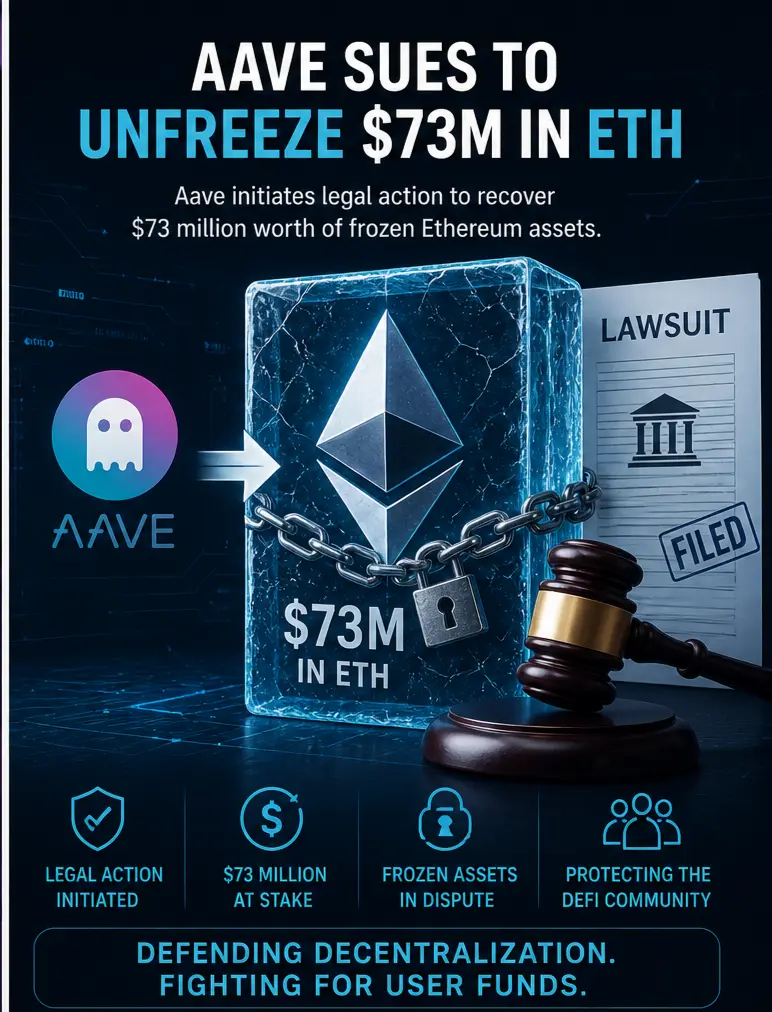
#AaveSuesToUnfreeze73MInETH The decentralized finance (DeFi) space has been shaken by a major legal and financial development as Aave moves to take legal action in an effort to unfreeze approximately $73 million worth of Ethereum. This case highlights a growing tension within the crypto industry—where decentralized systems are increasingly intersecting with traditional legal frameworks. It marks a critical moment not only for Aave but for the broader DeFi ecosystem, raising questions about control, governance, and the limits of decentralization.
At its core, the situation revolves around froze
ETH-1.41%
AAVE-0.39%
post-image
post-image
  • Reward
  • 20
  • Repost
  • Share
Crypto_Buzz_with_Alex:
2026 GOGOGO 👊
View More
  • Pin