
Futures
Access hundreds of perpetual contracts
CFD
Gold
One platform for global traditional assets
Options
Hot
Trade European-style vanilla options
Unified Account
Maximize your capital efficiency
Demo Trading
Introduction to Futures Trading
Learn the basics of futures trading
Futures Events
Join events to earn rewards
Demo Trading
Use virtual funds to practice risk-free trading
Launch
CandyDrop
Collect candies to earn airdrops
Launchpool
Quick staking, earn potential new tokens
HODLer Airdrop
Hold GT and get massive airdrops for free
Pre-IPOs
Unlock full access to global stock IPOs
Alpha Points
Trade on-chain assets and earn airdrops
Futures Points
Earn futures points and claim airdrop rewards


Promotions
AI
Gate AI
Your all-in-one conversational AI partner
Gate AI Bot
Use Gate AI directly in your social App
GateClaw
Gate Blue Lobster, ready to go
Gate for AI Agent
AI infrastructure, Gate MCP, Skills, and CLI
Gate Skills Hub
10K+ Skills
From office tasks to trading, the all-in-one skill hub makes AI even more useful.
GateRouter
Smartly choose from 40+ AI models, with 0% extra fees


Coinbase Research: Neutral Outlook for the Cryptocurrency Market in Q2, Geopolitical Conflicts Dominate the Overall Situation
Source: Coinbase
Translation: Felix, PANews
Coinbase Institutional and Glassnode jointly release the Q2 2026 “Charting Crypto” report, which states that due to the ongoing and highly uncertain geopolitical landscape, the outlook for the cryptocurrency market in Q2 2026 is neutral.
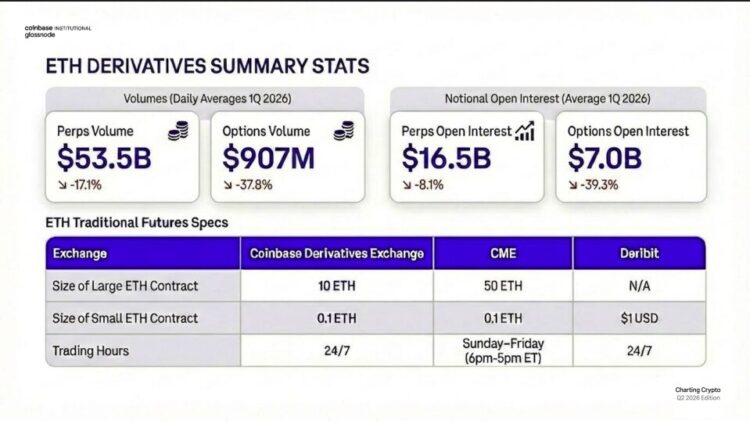
PANews has summarized the key points of the report, below are the details.
The current geopolitical situation remains ongoing and highly uncertain, making it difficult for short-term investments to be confidently made. Therefore, the report suggests adopting a risk-reward balanced strategy in the current environment.
Financial markets are mainly driven by macroeconomic events and the latest developments in Middle Eastern conflicts, which are changing rapidly.
Although the ultimate impact of the conflict on the global economy remains unclear, the International Monetary Fund (IMF) issued a statement lowering this year’s global GDP growth forecast from 3.4% to 3.1%, on the condition that “the duration and scope of the conflict remain limited.”
However, the Oxford Economics Institute estimates that a severe disruption in oil supply could slow global GDP growth to 1.4% in 2026, as “the United States and most major developed economies will fall into recession.”
The crypto market still faces some significant special factors, such as regulatory developments and the rise of AI. But these factors are far less important than the broader uncertainties, which make market participants hard to predict.
The report cautiously and optimistically believes that the macro situation has shifted to a positive stance, which may help many crypto assets bottom out in the short term and recover later in this quarter.
In fact, technical indicators for cryptocurrencies and stock markets have generally turned positive, but this still depends on whether Iran can reach an agreement.
Apart from geopolitical issues, the IMF Spring Meeting recently gathered finance ministers and central bank governors to discuss the systemic risks that may be brought by the new Mythos AI model launched by Anthropic.
The report believes that the model’s ability to exploit security vulnerabilities could impact future markets.
Meanwhile, the report highlights two endogenous factors in the crypto space worth monitoring in the medium to short term: the progress of the CLARITY Act and advancements in post-quantum cryptography.
It is worth noting that the report suggests that if the Middle Eastern conflict is thoroughly resolved, accompanied by falling oil prices and easing inflation, it could help risk assets overall strengthen.
Positive regulatory developments could also stimulate enthusiasm for cryptocurrencies. Conversely, escalation of the conflict and rising oil prices could undermine investor confidence and hinder global economic growth, as the risk of a recession increases.
Global Investor Survey
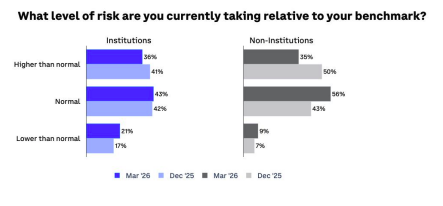
From March 16 to April 7, 2026, a survey was conducted among 91 global investors (29 institutional investors and 62 non-institutional investors) to understand their views on crypto market trends, industry positioning, risk management, and more.
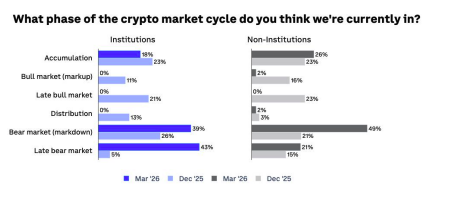
The survey shows that by the end of Q1, investors’ perspectives had shifted noticeably toward a bearish outlook at the cycle’s end. Currently, about 82% of institutional investors and 70% of non-institutional investors believe the market is in a bear market (declining) or at the end of a bear market, up from 31% and 36% in December 2025.
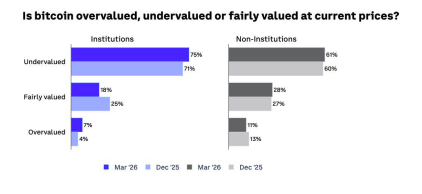
However, investors still believe Bitcoin is severely undervalued.
Three-quarters of institutional investors (75%) and about three-fifths of non-institutional investors (61%) think Bitcoin is undervalued, with little change compared to December last year; only 7% of institutional investors and 11% of non-institutional investors believe Bitcoin is overvalued.
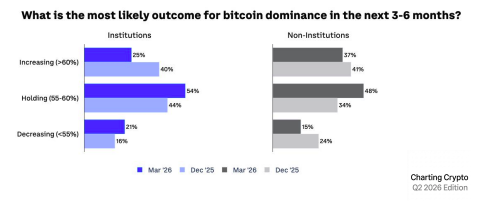
Additionally, expectations for Bitcoin dominance have shifted to a “steady state.”
The proportion of institutional investors expecting Bitcoin dominance to rise has decreased from 40% to 25%, while most institutional investors (54%) now expect dominance to remain near current levels (up from 44%), with another 21% expecting it to decline.
Market Overview
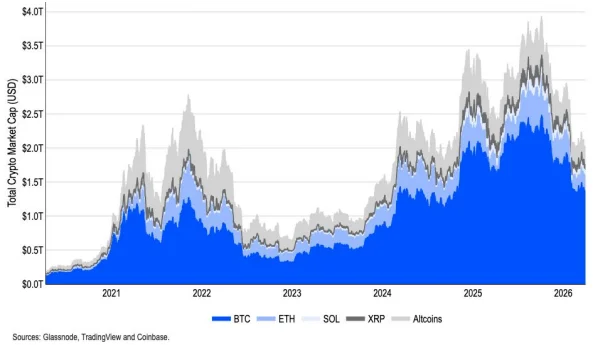
Affected by broad sell-offs, the total cryptocurrency market cap (excluding stablecoins) declined by about 18% in Q1 2026.
Notably, during the same period, the total supply of stablecoins increased from $308 billion to $318 billion, indicating some sellers may have chosen to stay within the crypto ecosystem, waiting for market volatility to subside.
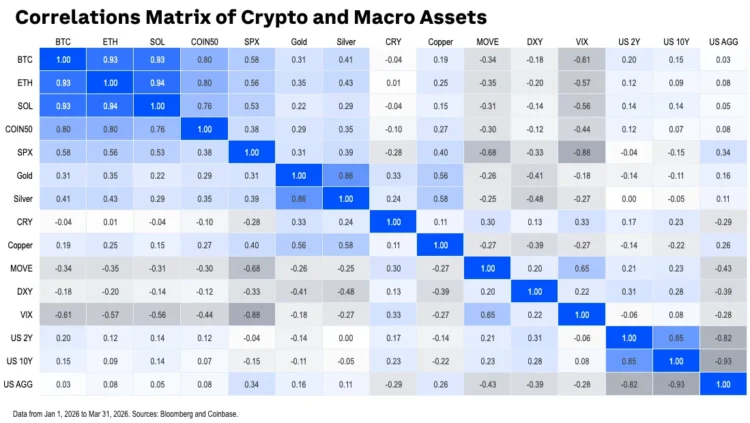
In terms of correlation with macro assets, in Q4 2025, Bitcoin’s daily returns correlated with US stock returns (represented by the S&P 500) rose to 0.58, meaning that although there are some differences in absolute performance metrics, this correlation remains statistically significant.
At the same time, most crypto market participants are disappointed that Bitcoin’s correlation with gold remains minimal, as gold has become one of the best-performing assets in 2025.
Cryptocurrency and macro asset correlation matrix
Bitcoin
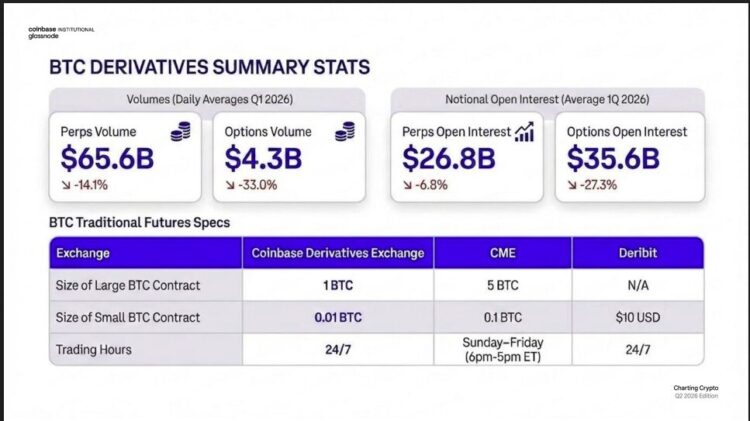
In Q1 2026, Bitcoin options open interest grew slightly by 2.4% (compared to the end of Q4 2025), while perpetual contract open interest saw a larger rebound, increasing by about 8.6%.
The latter suggests that after the deleveraging event on October 10, 2025, the Bitcoin market structure may be returning to normal.
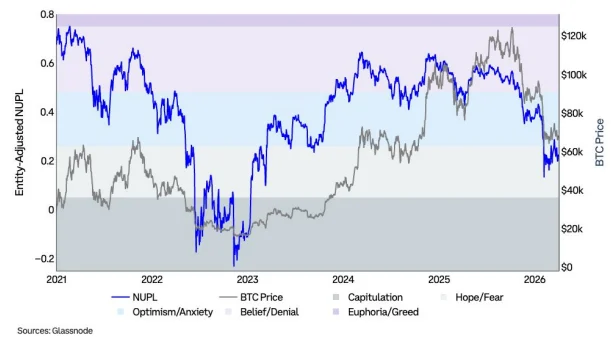
Unrealized Profit/Loss (NUPL) is the difference between relative unrealized profits and relative unrealized losses. These ranges aim to reflect the sentiment of different investors.
Based on the NUPL indicator, after the sell-off in February, investor sentiment shifted from anxiety to fear and remained so until the end of Q1 2026.
Especially during the early stages of the Iran conflict, this sentiment persisted.
Recently, the indicator seems to have broken into the optimistic zone in April, but it remains largely driven by news events.
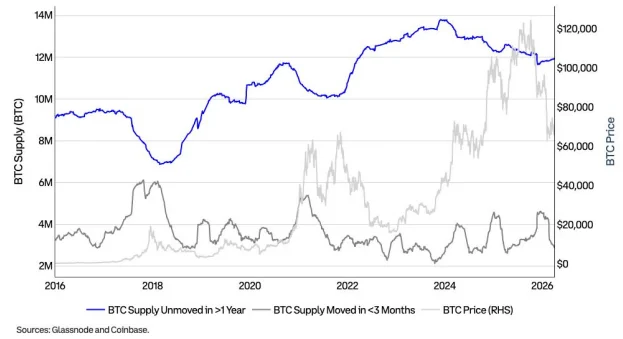
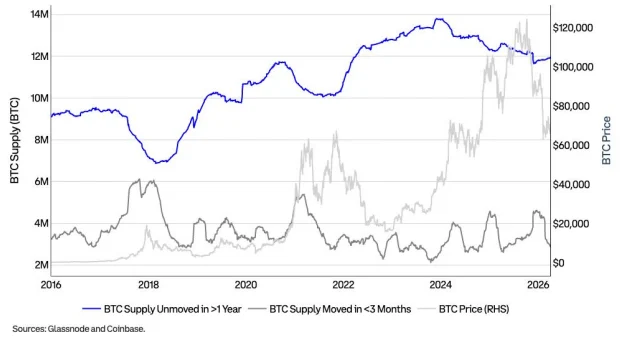
The supply of Bitcoin traded within the past three months decreased by 37% in Q1 2026, while the proportion of supply that has not been traded for over a year increased by 1%, indicating some pure speculators may have been pushed out of the market.
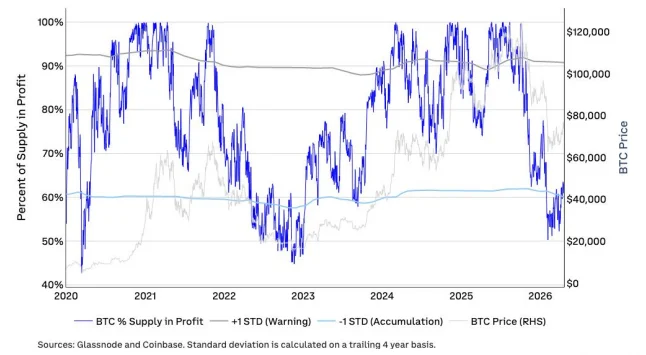
The chart below shows the percentage of Bitcoin supply in profit, along with two statistical zones set at +1 and -1 standard deviations.
These zones represent important warning and accumulation zones.
The indicator currently shows Bitcoin in an accumulation zone, confirming an optimistic technical pattern entering Q2 2026.
The chart below compares the circulating supply of Bitcoin that has not been traded for at least a year with the supply of recently (within three months) active traded Bitcoin.
In Q1 2026, the supply of recently traded Bitcoin decreased by 37%, while the supply of Bitcoin not traded for over a year increased by 1%, indicating some pure speculators may have been pushed out of the market.
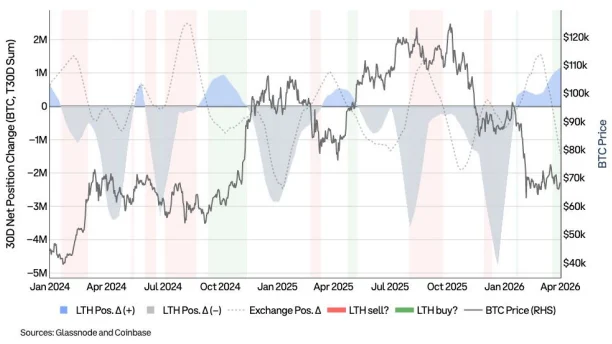
The chart below shows the net change in long-term holder positions (based on a 155-day or longer threshold) and the net change in exchange holdings.
The report suggests that the synchronization of these two data points (i.e., increases in long-term holdings and decreases in exchange holdings) can reveal the actual timing of profit-taking.
The highlighted green periods indicate that long-term holders increased their holdings while exchange holdings decreased, suggesting tokens are leaving exchanges and that long-term holders are more inclined to accumulate rather than disperse during these times.
Ethereum
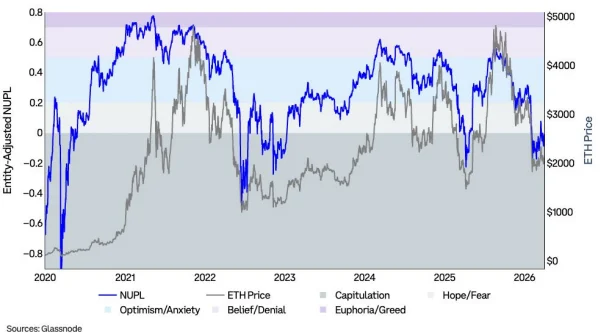
During the sell-off in early February 2026, the NUPL fell below the “capitulation” phase and remained in that phase for most of Q1 2026, but since early April, market sentiment has begun shifting toward the “hope” phase.
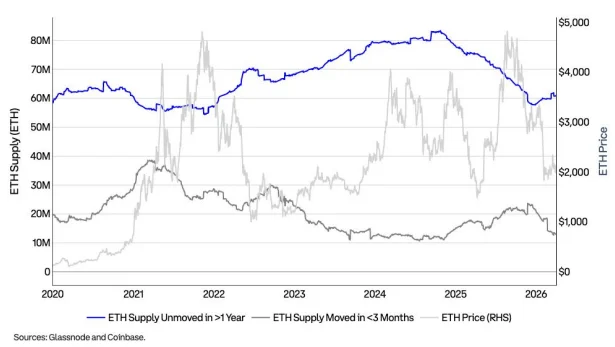
In Q1 2026, the share of ETH that has not moved for over a year increased by 1%, while the share that moved within the past three months decreased by 38%, indicating many pure speculators may have been pushed out of the market.