As DeFi applications gradually expand across multi-chain ecosystems, users often have to go through several steps to complete a single on-chain operation, such as cross-chain bridging, asset swaps, approvals, and protocol interactions. These complex processes not only raise the barrier for users, but also force developers to devote significant resources to handling the underlying execution logic.
As a result, the market has started to need a more efficient execution method, one that can abstract complex multi step operations into automated flows where users only need to express their goals. Enso’s Intent execution mechanism emerged in response to this need. It can turn user intent into an automated execution path, simplifying the process of multi-chain DeFi operations.
What Is Enso’s Intent Execution Mechanism?
The core logic of the Intent execution mechanism is to let users describe only “what outcome they want to achieve,” without having to specify “how the process should be completed.” For example, a user only needs to state that they want to bridge assets to another chain and deposit them into a certain yield protocol. The system will then automatically complete steps such as bridging, swapping, and depositing.
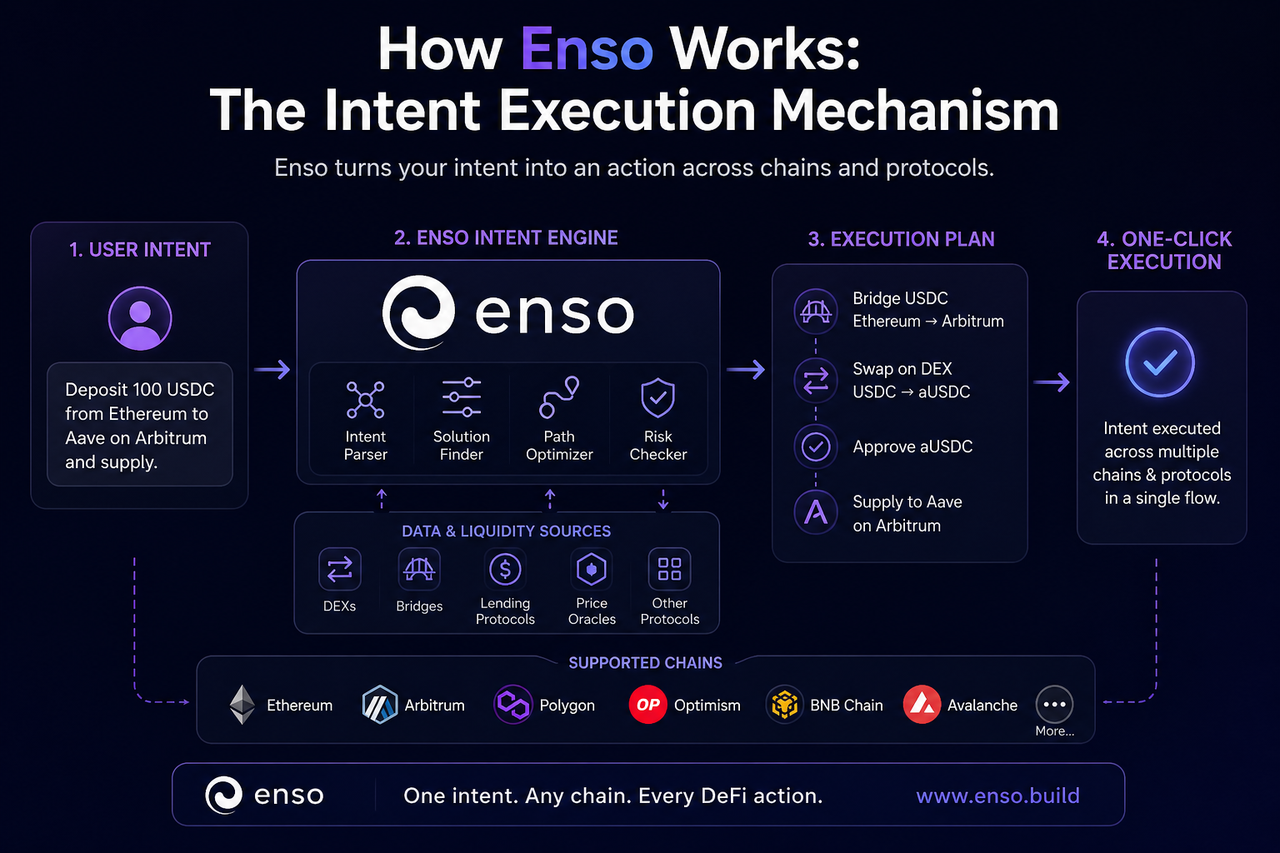
This is the mechanism Enso uses to turn complex on-chain interactions into automated execution flows. It generates the optimal path in the background and coordinates interactions between different protocols, allowing users to complete tasks that would otherwise require multiple transactions through a single operation. This model greatly reduces the complexity of using multi-chain DeFi.
What Does Enso’s Execution Flow Look Like?
Enso’s execution flow mainly includes three stages: the user submits a goal, the system generates a path, and the transaction is executed on-chain. First, the user submits a clear objective, such as transferring a certain asset to a target chain and participating in a specific protocol. Enso then automatically breaks down the task based on that goal and selects the appropriate cross-chain bridge, swap route, and protocol interaction method.
After path planning is complete, the system combines these steps into a single on-chain execution task. Users can complete complex processes without manually operating across multiple protocols. This automated execution mechanism reduces intermediate steps and improves transaction efficiency.
Why Is the Intent Execution Mechanism More Efficient Than Traditional Aggregators?
Traditional aggregators mainly solve the problem of trading route optimization, focusing on finding the best swap price. However, they cannot handle complex cross protocol operations. When users need to complete cross-chain actions or protocol interactions, they still have to carry out multiple steps manually.
Enso’s Intent execution mechanism extends further into the full task execution layer. It not only optimizes trading routes, but also automatically completes cross-chain bridging, protocol interactions, and the integration of multi step tasks. This approach reduces the number of actions users need to take and allows developers to implement complex features more efficiently, making it better suited to multi-chain DeFi application scenarios.
What Value Does Enso’s Intent Execution Bring to DeFi?
The greatest value Enso’s execution mechanism brings to DeFi is that it turns complex operations into a simple experience. For users, this means cross-chain actions and protocol interactions no longer need to be completed manually step by step, lowering the barrier to use. For developers, it reduces the work required to build underlying logic and allows them to create automated products more quickly.
As DeFi use cases become increasingly complex, execution efficiency and the degree of automation are becoming core competitive advantages. Enso’s Intent execution mechanism enables protocols to provide one stop on-chain services more efficiently, giving it significant value within multi-chain infrastructure.
Conclusion
Enso’s Intent execution mechanism automatically breaks down tasks, plans routes, and executes them on-chain, integrating complex multi-chain DeFi operations into a single transaction. Compared with traditional aggregators, this model not only optimizes paths, but also handles complete task execution, allowing both users and developers to participate in multi-chain DeFi more efficiently.
As DeFi moves toward automation and modularity, the importance of Intent execution mechanisms continues to grow. As a representative project of this execution layer infrastructure, Enso is helping push DeFi interactions toward a simpler and more efficient future.
FAQs
What Does Enso’s Intent Execution Mechanism Mean?
Enso’s Intent execution mechanism is an automated execution system. Users only need to express their goal, and the system automatically plans the path and completes operations such as cross-chain transfers, swaps, and protocol interactions.
How Does Enso Simplify multi-chain DeFi Operations?
Enso combines cross-chain bridging, asset swaps, and protocol interactions into a single execution flow, reducing the number of manual steps required from users and improving both efficiency and experience.
How Is Enso Different from Traditional Aggregators?
Traditional aggregators only optimize trading routes. Enso not only optimizes routes, but also executes complete tasks, including cross-chain and multi protocol interactions.
Why Is the Intent Execution Mechanism Important?
Because multi-chain DeFi operations are becoming increasingly complex, the Intent execution mechanism can reduce development complexity and improve the user experience, making it an important foundation for DeFi automation.







